
Bears can be found in North America, South America, Europe and Asia. There are 8 species of bear around the world. They live in different climates and terrains. The largest distinct bear species is the Polar bear, which can weigh up to 680 kg, stand up to 10 feet tall on its hind legs, and 5 feet tall at the shoulder, while the largest male Kodiak brown bear rivals the polar bear, weighing over 680 kg, standing over 10 feet tall on their hind legs, and 5.5 feet tall at the shoulder. On the other hand, the smallest species of bear is the Sun bear, which weighs around 68 kg, stands about 4.11 feet tall on its hind legs, and 4.5 feet tall at the shoulder. In animal classification, bears are in the Ursidae family. These mammals are omnivores, which means that they eat a variety of things. This can include meat, plants and insects. Most bears are shy, reclusive, and naturally try to avoid humans whenever they can. However, some bears are mighty and become aggressive when they feel threatened or when their territory is invaded. They are also very curious and can be quite playful when not trying to run away from people.
The scientific family name for all bears is Ursidae. There are 8 living species of bears, which are divided across 5 different genera within the family Ursidae:
So, individual species have their own distinct binomial names or specific two-part scientific names. For example, the scientific name of the Brown bear is "Ursus arctos". The word Ursus is Latin for 'bear', and the specific epithet 'arctos' means 'bear' in Greek. As usual, the scientific name of the American Black bear is "Ursus americanus", the Polar bear is "Ursus maritimus", the Asian black bear is "Ursus thibetanus", the Giant panda is "Ailuropoda melanoleuca", the Sloth bear is "Melursus ursinus", the Spectacled bear or Andean bear is "Tremarctos ornatus", and the Sun bear is "Helarctos malayanus".
Within the family Ursidae, "Ursus arctos middendorffi" is the scientific name of the massive Kodiak bear, another subspecies of the Brown bear, like the Grizzly bear, whose scientific name is "Ursus arctos horribilis".
Bears are classified as both caniforms and doglike carnivorans. They are widespread, appearing in a wide variety of habitats throughout the Northern Hemisphere and partially in the Southern Hemisphere. Only 8 species of bears are extant. Here are some facts and features about bears:
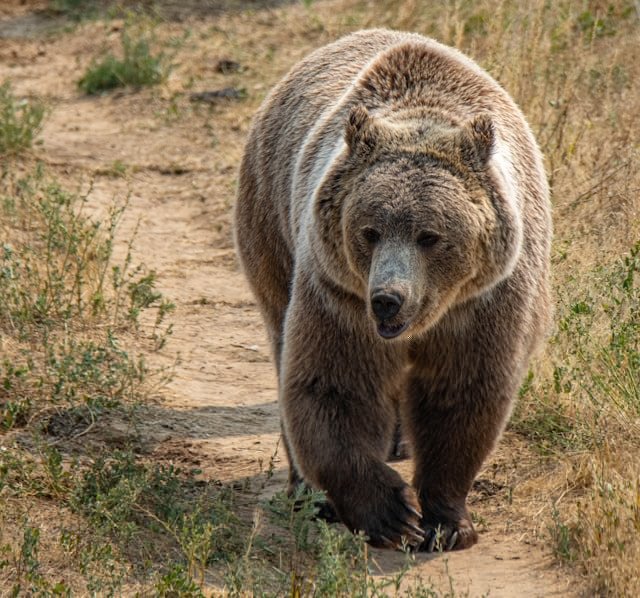
The appearance of a bear can vary depending on its species. These mammals come in many different shapes and sizes. They have a variety of colours with thick, shaggy fur. Most bears have large, bulky bodies with wide heads, relatively short necks, short legs, and short tails. Some bears have distinctive humps on their back. Bears also have small rounded ears, small eyes, and long snouts that house their powerful sense of smell, strong jaws and flat molars. Their snout length varies by species. Modern bears (like brown bear, grizzly bear, American black bear, and sloth bear) generally have long snouts (muzzles), while the giant panda and spectacled bear have relatively shorter, broader, and more rounded snouts. However, bears have flat soles and five enormous, sharp, non-retractable claws on each plantigrade paw. They are also good climbers and swimmers. For example, the Asiatic black bear is an excellent tree climber, as are most bear species.
The average shoulder height on all four legs of an adult bear ranges from 2 to 5 feet, and body length ranges from 4 to 8 feet, depending entirely on the species and sex. Their weight also ranges from 45 to 680 kg, depending on the species, sex, age, location, and season. These figures represent horizontal length, from the tip of the nose to the base of the tail while standing on all four legs, and this is different from their vertical length or standing height on their hind legs, which ranges from 6 to 10 feet.
For example, the largest bear species is the Polar bear, and the male bear is significantly larger than the female. They can be up to twice the physical size and weight of adult females. This species stands about 2.6 to 5.3 feet tall at the shoulder on all four legs, has a horizontal body length of 5.9 to 8.9 feet from nose to tail, vertically stands 6 to 10 feet tall on hind legs, and weighs 150 to 680 kg or more. A large male polar bear stands about 4 to 5.3 feet tall at the shoulder on all four legs, has a horizontal body length of 7.9 to 8.9 feet from nose to tail, vertically stands about 8 to 10 feet tall on its hind legs, and weighs 350 to 680 kg or more. In comparison, a large female polar bear stands about 2.6 to 3.9 feet tall at the shoulder on all four legs, has a horizontal body length of 5.9 to 6.9 feet from nose to tail, vertically stands about 6 to 8 feet on its hind legs, and weighs about 150 to 320 kg. On the other hand, the smallest species is the sun bear, which stands about 2 to 2.4 feet tall at the shoulder on all four legs, has a horizontal body length of 3.5 to 4.5 feet from nose to tail, vertically stands about 4 to 5 feet tall on its hind legs, and weighs around 25 to 70 kg. A male sun bear stands about 2.2 to 2.4 feet tall at the shoulder on all four legs, has a horizontal body length of 4 to 4.5 feet from nose to tail, vertically stands about 4.5 to 5 feet tall on its hind legs, and weighs about 45 to 70 kg. In comparison, a female sun bear stands about 2 to 2.2 feet tall at the shoulder on all four legs, has a horizontal body length of 3.5 to 4 feet from nose to tail, vertically stands about 4 to 4.5 feet tall on its hind legs, and weighs about 25 to 50 kg.
The anatomy of a bear is as fascinating as it is intimidating. These massive creatures have evolved over millions of years to become some of the most powerful animals in the world. From their flat molars to their enormous, sharp, non-retractable claws, bears are built to hunt and defend themselves against predators. One of the most notable features of a bear's anatomy is its fur. Their thick, shaggy fur coat keeps them warm in cold climates and helps to protect them from scratches and bites from other animals. This thick hair also makes them appear larger than they are, which can be useful when trying to intimidate rivals or predators. However, their sense of smell is exceptionally sharp to find food, though their sight and hearing are weaker. Bears' five non-retractable claws on each plantigrade paw help them dig for food, climb trees, and tear rotting logs, meat or objects apart, while their powerful jaws and flat molars are adapted to crush both vegetation and flesh. Additionally, bears have strong digestive systems that allow them to digest food quickly, so they can get back to foraging. Another key feature of a bear's anatomy is its muscular structure. Bears have incredibly strong shoulder muscles and immense forepaws that are capable of breaking an animal's spine and swimming across rivers with ease. They walk flat on the soles of their feet like humans do, which creates a lumbering gait, and their short tails help them balance when they stand on their hind legs. Bears' strength also comes in handy when defending their territory or fighting other bears for resources such as food or mates.
Bears can be found in many places across North America, South America, Europe and Asia. They live in a variety of habitats, including forests, woodlands, mountainous areas, valleys, open meadows, wooded lowlands, grasslands, dense brushy swamps, coastal areas, Arctic sea ice and even tundra. However, they also use natural cover like caves, hollow logs, rocks, and thick bushes for shelter. Many bears dig out dirt dens in hillsides to sleep and have babies during the winter. But their exact habitat depends on the bear species and what they like to eat.
For instance, brown bears and grizzlies need a lot of space to roam and hunt. They prefer mountain forests, foothills and open meadows. While brown bears are found across North America, Europe and Asia, grizzly bears are found in inland North America. On the other hand, American and Asian black bears prefer thick forests and wooded lowlands of North America and Asia. Additionally, polar bears live on Arctic sea ice and frozen ocean waters near the North Pole and the Arctic, and giant pandas live in high bamboo forests in China. Andean bears, or spectacled bears, live in the mountain cloud forests of South America; sun bears live in warm wooded lowlands and grasslands in Southeast Asia, and sloth bears are found in the dry forests, moist forests and grasslands of India and the Indian subcontinent.
There are eight living species of bears in the world, most notably the Brown bear, the American Black bear, and the Polar bear. They have different characteristics, and these species split into various regional subspecies adapted to local climates and habitats.
Bears are large, heavy mammals with stocky bodies. They have relatively short necks, short legs, and very short tails. Bears have shaggy hair, small rounded ears, long snouts, and unusually small eyes for such large animals. Their sense of smell is exceptionally sharp to find food, though their sight and hearing are weaker. Bears walk flat on the soles of their feet like humans do, which creates a lumbering gait. Their five non-retractable claws on each plantigrade paw help them dig, climb, and tear objects apart. Most bears have an omnivorous diet, and they eat plants, berries, insects, and meat except for the carnivorous Polar bear and the herbivorous Giant panda. Their flat molars are adapted to crush both vegetation and flesh. Many species slow their heart rate and sleep through cold months (winter dormancy) using stored body fat. However, bears are generally solitary and shy in nature. They live alone except when mothers raise their young cubs. Mother bears are affectionate, protective, devoted, strict, sensitive and attentive to their young. These animals prefer to avoid humans, and they can be dangerous if surprised or threatened.
Bare found on the continents of North America, South America, Europe, and Asia, and their homes range from hot tropical to cold Arctic ice. Each kind of bear likes a different home. The most common habitats for bears are forests, mountainous regions, and open lands, while they also adapt to grasslands, Arctic tundra, and ice floes. For example, American and Asian black bears live in forests and woodlands, using thick woods with trees for climbing, while brown bears and grizzlies roam high mountains, foothills and grasslands. On the other hand, polar bears are found in Arctic and tundra regions, living on ice and frozen ocean waters. But sloth bears and sun bears are found in tropical and dry forests. Depending on the species, they also find shelter in caves, hollow trees, or dense brush.
Bears are mostly opportunistic omnivores that eat a mix of plants and animals. Their diet depends on what is available in their environment. Most of their diet, up to 90% for some species, actually comes from plant matter, including berries (raspberries, blueberries, and blackberries), nuts (acorns, hazelnuts, and pine nuts), flowers, fruits (local fruits), greens (tender spring grasses, shoots, sedges, and leaves), roots (sweet-vetch roots and lily bulbs), and they all love the taste of honey, alongside insects (ants, termites, grubs, and beetle larvae), fish (salmon and trouts), small rodents (ground squirrels, pikas and voles), and larger hoofed animals (deer, elk, moose calves and yound or weak caribou). These opportunistic feeders also eat carrion. They scavenge on dead animal carcasses left by other predators or natural death.
Depending on the season and their location, bears may have a diet that is mostly plant-based or mostly meat-based. During spring, they wake up hungry after hibernation and look for food all day long. This season, they actively focus on new green shoots, roots, bugs, and scavenging winter-killed animals' carcasses. But in regular summer months, their intake is lower. This time, bears heavily focus on succulent plants, early berries, insects, and catching fish, while in fall (hyperphagia), when they are most active, they consume massive amounts of berries (huckleberries, blueberries, and buffaloberries), nuts, and high-calorie meat daily to gain thick fat layers before winter hibernation. During the period known as hyperphagia (a period of intense eating), large bears search for food up to 20 hours a day and typically consume between 20,000 and 30,000 calories (or even more) per day to build fat for winter.
Though bears are considered omnivores, their diet depends on the species and place. For example, polar bears mostly eat seals (ringed and bearded seals), Arctic birds (waterfowl), bird eggs, whales that wash ashore and occasional walruses. They are hypercarnivorous, with a diet consisting of more than 70% meat, and they are capable of eating vegetation like kelp, berries, and grasses. In comparison, American black bears mostly eat berries, fruits, acorns, nuts, insect larvae and insects when available, and giant pandas mostly eat bamboo, about 99% of their diet, though they'll also eat small animals or eggs.
When they do hunt, their strategies rely heavily on raw power, surprise, and targeting vulnerable or young prey, and their tactical approach varies significantly depending on the species and the environment. Bears use their strong shoulder muscles and immense forepaw blows, capable of breaking an animal's spine, combined with powerful bites to the neck, back, or snout, while they use their long, sharp, curved claws to catch prey and tear rotting logs or objects apart. However, bears rely on an exceptional sense of smell to locate buried caches, carcasses or scattered food sources over miles. Their powerful jaws and flat molars are also adapted to crush both vegetation and flesh. Additionally, bears have strong digestive systems that allow them to digest food quickly, so they can get back to foraging.
One of the things that makes bears so interesting is their behaviour. Bears are generally solitary, shy animals that prefer to avoid humans. Their behaviour is driven by curiosity, an exceptional memory for food locations, and a strong instinct to protect their personal space, food, or cubs. The behaviour of different types of bears can vary greatly. For example, black bears are typically shy and retiring, while grizzly bears can be aggressive and dangerous.
Bears are incredibly intelligent animals. They can learn new things quickly and are problem-solvers that remember food sources year after year. Bears standing on their hind legs indicates curiosity and a desire to see, hear, or smell better. They have an amazing sense of smell, which allows them to track prey over long distances. While often perceived as slow or clumsy, they are highly adaptable apex predators and ecosystem engineers capable of running up to 50 km/h, climbing trees with agility, and swimming long distances. After a successful large kill, bears drag the carcass to a secure spot and cover it with soil, moss, leaves, or snow to hide it from scavengers. Bears occasionally submerge remains in running water to help preserve the prey for consumption over several days. They spend the winter months in dens and enter a dormant state (hibernation), but brown bears are not full hibernators, so they can be woken at any time. Bears are typically solitary animals, except for mothers raising cubs and will congregate around food sources. They express their nervousness by grunting, chuffing or moaning. However, bears often make warning signs with loud noises (like jaw popping and huffing), swatting the ground with their paws, and lowering their ears to scare away potential threats and mean they want space.
Bears generally live a solitary, nomadic lifestyle centred around seasonal foraging, territory management, and winter dormancy. Adults live entirely alone except during the mating season and when mothers raise cubs. They are territorial animals but will temporarily congregate in groups around food sources or at rich feeding sites like salmon runs, called a “sleuth" or a "sloth”. The leader of a "sloth” is usually the biggest, strongest, and oldest bear, whose confidence dictates who eats first. They use their size and strength to protect themselves from predators and intimidate other bears. Bears rarely communicate using sound, staying mostly quiet, but they use a "play-face" (an open-mouth grin) to signal peaceful intentions, and will huff, woof, or roar when alarmed or aggressive. These territorial animals will mark their territory with urine or scent posts to navigate, avoid hunters, and locate food from over a mile away. While bears may defend a food resource or mate at their present, they are not very territorial. They do not patrol or protect a specific area from intrusion by other bears. Bears respect a certain personal space, but often several animals overlap each other's living space at different times. Furthermore, female bears give birth to 1 to 4 cubs inside the winter den, and they are fiercely protective. Mothers communicate with their cubs by grunting, chuffing or moaning.
Most bears are highly flexible omnivores, but specific diets vary greatly across the eight living species. For example, brown bears and black bears are omnivores, and they eat a variety of things with a shifting seasonal diet of berries, roots, nuts, plants, insects, and fish, while the polar bear lives an almost exclusively carnivorous lifestyle on Arctic sea ice, hunting and feeding mainly on seals and walruses. On the other hand, the giant panda lives a highly specialised lifestyle, spending up to 12 hours a day eating bamboo. The sloth bear uses flexible, funnel-like lips to suck up termites, and the sun bear uses exceptionally long claws to raid bee nests for honey. Bears are crepuscular; they usually forage during dawn and dusk (in the morning and evening) and rest in cover by day. However, they are active at any time of the day and can shift to nighttime activity near humans. They spend the winter months in dens, lowering their metabolism, living off stored body fat, and entering a dormant state (hibernation). Additionally,
Bears hibernate during winter, usually from November to May. During the autumn, they enter a state of extreme eating to accumulate massive fat reserves, which is called "hyperphagia", and then they prepare for hibernation by getting into a den and curling up into a ball. While often called hibernation, a bear's winter sleep is actually a state of torpor. During hibernation, a bear’s heart rate slows down from 40 to 50 beats per minute to about 8 beats per minute, and their metabolism drops drastically. Bears go up to 100 days without eating, drinking, or excreting waste. Their brains also go into a short-of-sleep mode, which helps them conserve energy. In fact, during hibernation, bears can use up to 85% less energy than they do when they’re awake. Most northern species retreat to caves, hollow logs, or self-dug burrows for winter dormancy. However, they can wake up quickly if disturbed or threatened.
Bears have one of the slowest reproductive rates among all land mammals, because mother bears invest so much time raising their cubs that they only reproduce every 2 to 4 years. They reach sexual maturity between ages 3 and 5. During this time, solitary adult bears use their sharp sense of smell to track each other across long distances. When they find each other, male bears fight fiercely for dominant breeding access to females. A male and female stay together for a few days up to a couple of weeks to mate repeatedly. They mate during the spring and summer (May to July), using a unique process called delayed implantation, where fertilised eggs wait to attach to the womb until autumn (the embryo stops developing and floats freely in the uterus for several months). While fertilised eggs stay dormant for months, the mother focuses on eating and storing heavy fat supplies for winter. If the mother is healthy and has gained enough fat reserves during summer and fall, the embryo finally implants as a blastocyst in the uterine wall in late autumn (November), ensuring the brief active gestation occurs entirely during hibernation. Once implanted, the pregnancy truly begins, and actual fetal development takes only 6 to 8 weeks. If she lacks food or fat (underweight), her body will naturally absorb the embryo instead of completing the pregnancy. However, the pregnant female bear usually gives birth to 1 to 3 cubs (though litters of 4 can occur) inside the winter den in January or February while she is still in her winter sleep (hibernating).
Bear cubs are born incredibly small, blind, toothless, and nearly hairless. Their ears are sealed shut. A newborn cub weighs only about 250 to 450 grams, depending on the species. This is less than 1/600th of their mother's weight. Only the mother bear raises the young, and the mother does not eat or drink during this time. She relies entirely on her body fat to produce highly nutritious, fat-rich milk. Cubs grow quickly by drinking the mother's rich fat milk inside the safety of the den until spring emerges. Mother bears are fiercely protective, and they nurse for about 8 months. When the family finally leaves the den in spring, the cubs have grown significantly, weighing 4 to 5 kg. Bear cubs begin to eat solid food at 2 months old, and they stay with their mother for roughly 2 to 3 years before they venture out on their own, depending on the species. During this time, they learn from their mother how to climb to escape danger, forage, hunt specific prey, find safe dens to survive in the wild, avoid human threats and become independent. Intense play behaviour among young cubs is essential; scientific studies show that the more a cub plays, the higher its chances of surviving to adult independence.
Healthy bears generally live between 20 and 25 years in the wild. Only about half of all wild bear cubs survive past their first 3 years due to predators, starvation, harsh weather, and adult male infanticide. But they can live much longer in captivity (zoos or sanctuaries), often reaching 30 to 40 years due to medical care and guaranteed nutrition. The oldest known wild Kodiak bear was a 34-year-old sow.
In the wild, bears are apex predators. This means that they sit at the top of the food chain and have no natural predators. This position gives them a great deal of power and influence in their ecosystems. As a result, when bears enter human-populated areas, they can cause a great deal of damage.
There are many types of bears, all of which can be dangerous. Brown bears, Kodiak bears, and Polar bears are the most dangerous, as they are the largest. Black bears are not as dangerous as the other types of bears but can still be harmful if threatened or provoked. While bears usually try to avoid people, they can become aggressive when they feel threatened. People have been killed by bears in North America and around the world. It is important to know how to recognise a threatening bear and what to do if some one encounter one.
However, human activities also threaten to bears including, habitatloss and fragmentation, poaching and illegal trade, human-bear conflict, vehicle collisions, and climate change. Bears need large open spaces to roam and find food, but they are losing their habitat due to deforestation for agriculture, human housing, logging, and road development. They are also hunted illegally for their body parts like gallbladders, bile, paws, and fur to supply traditional medicine markets and luxury trade. As natural food sources shrink, the encroachment of some bear species into towns, attracted by accessible garbage and into rural areas for livestock and crops; they become close to people, resulting in conflicts with humans. Bears are also threatened by expanding road and rail networks across wildlife corridors, which lead to frequent, fatal car and train accidents. As climate change threatens biodiversity worldwide, warming temperatures melt Arctic sea ice, drastically reducing the hunting and breeding grounds that are vital for polar bear survival.
According to a recent study, the total global population of bears is estimated between 1.5 and 2 million across eight distinct species. The most populous types are the American black bear, which is roughly 800,000 individuals worldwide, mostly in North America, and the brown bear, with an estimated population of 100,000 to 200,000 individuals across North America, Europe, and Asia, but the grizzlies number is estimated around 55,000 individuals in North America, with about 30,000 in Alaska, up to 25,000 to 29,000 in Canada, and a small population about 2,000 bears in the contiguous U.S. Additionally, polar bears are next in line, numbering about 22,000 to 31,000 individuals across the Arctic Circle, encompassing the Arctic Ocean and its surrounding seas and landmasses, which include the northernmost regions of North America, Europe and Asia.
While the Asiatic black bear numbers tens of thousands of individuals spread across southern Asia and eastern Asia, the sloth bear population is estimated at around 10,000 to 20,000 individuals, primarily on the Indian subcontinent. The rare species, like the giant panda, number around 1,800 to 1,900 individuals, remaining in the wild in China, while the Himalayan brown bear population is only in the hundreds or low thousands. On the other hand, the spectacled bear or Andean bear, population is estimated at the low tens of thousands in South America, and the tiny sun bear population number is unverified, but considered declining and vulnerable.
Bears have been around for about 30 to 40 million years, but their population are quickly dwindling. Most species are classified as vulnerable, except the six out of the world's eight bear species, which are officially classified as threatened with extinction. Because their population are decreasing by about 20% every decade, and the main reasons for the decline in bear populations are habitat loss, illegal hunting, and rising human-bear conflicts.
Bears play an important role in the environment. They are crucial to maintaining a balanced ecosystem due to their role as apex predators.
Bears are majestic creatures that have intrigued humans for centuries. We have seen them in the wild, on TV shows, and even in zoos. Speaking of zoos, these facilities play a significant role in keeping bears safe and protected from extinction. They are popular with visitors of all ages, from children to adults. Zoos provide an environment where people can observe bears up close and learn about their behaviours and their natural habitats.
Bear enclosures in zoos are designed to mimic the natural habitats of these animals. They typically include vegetation, rock formations, streams, water features and other elements that would be present in the wilderness. Some zoos also use artificial caves or dens so that bears can hibernate during the winter months, just like they would in the wild. Bears are also provided with ample space to roam around and exercise, something that is crucial for their physical health and well-being. Visitors can watch as the bears go about their daily activities such as foraging for food or taking a dip in the pond.
Bears belong to the family Ursidae, which includes eight bear species split across five different genera. Within this family, the 8 living species of bears are also classified into three different subfamilies:
The classification of bears is based on morphological characteristics and genetic analysis, revealing their close relationship with other carnivores like dogs, seals, and walruses. Interestingly, despite their fierce reputation, bears are classified as omnivores due to their varied diet of plants, insects, fish, and occasionally meat.
Bears have evolved over millions of years to adapt to various environments, from the icy Arctic tundra to lush forests. The evolution of bears can be traced back to the early ancestors known as miacids (small, flexible-bodied, tree-dwelling carnivores similar to modern weasels, martens, or civets) (dog-like ancestors) that lived roughly 62 to 33 million years ago. They are widely recognised as th ancestral group for the entire modern order Carnivora. Over time, these small carnivorous mammals underwent significant changes in morphology and behaviour to become the diverse group we recognise today. The miacid lineage split into distinct evolutionary branches, giving rise to all modern bears, dogs, raccoons, and weasels. Around 40 to 45 million years ago, miacids diverged into two main suborders:
Bears emerged directly from the Caniformia branch. The earliest primitive "bear-like" animals, such as Parictis and Allocyon, developed from the caniform ancestors during the late Eocene and Oligocene epochs. This lineage eventually transitioned into the genus Ursavus, the genus of the first True Bear, often called the dawn bear (Ursavus elmensis), which emerged in Europe about 20 to 23 million years ago. It was roughly the size of a fox or small dog, lived during the Miocene epoch and is the direct progenitor of all modern bears. Ursavus developed specialised teeth capable of crushing vegetation, marking the transition from a purely meat-based diet to an omnivorous one.
The Giant Panda line (Ailuropodinae) was the first to split from the main bear family tree approximately 19 million years ago and evolved more specialised diets, such as bamboo. Due to global cooling and expanding grasslands, the Tremarctinae subfamily branched off. This group included the giant, long-legged, short-faced bears (Arctodus and Arctotherium), which were built for long-distance running and scavenging. Arctotherium angustidens in South America became the largest known mammalian land predator to ever live. Today, the Spectacled bear is the only living survivor of this branch. However, the subfamily Ursinae, which includes the modern Brown bear, Black bear, Sun bear, and Sloth bear, descended from Ursus minimus about 5 to 6 million years ago. Driven by shifting Ice Age climates, land bridges, and minor extinction events, these bears rapidly expanded globally and have a more varied omnivorous diet. On the other hand, the Polar bear is the most recently evolved bear species. This species split directly from an ancestral population of brown bears between 300,00 and 1 million years ago. It adapted rapidly to the harsh Arctic environment by developing white, water-repellent fur, webbed paws for swimming, and a specialised metabolism to digest marine mammal blubber. The Polar bear is hypercarnivorous, getting over 70% of its food from meat. Despite their different habitats, all bear species share common characteristics such as powerful claws for digging and climbing, a keen sense of smell, and impressive strength.
Furthermore, bears have played an essential role in various ecosystems as apex predators, influencing prey populations and shaping their surrounding environment. This adaptability has allowed bears to survive in different ecosystems ranging from tundra regions to dense forests.
Bears have a complex relationship with humans that has been evolving over centuries. While some may view bears as intimidating and dangerous predators, others see them as symbols of strength and wisdom in various cultures around the world. From ancient myths and folklore to modern-day encounters in the wild, the interactions between bears and humans have been both captivating and sometimes dangerous. The reality is that human actions have largely shaped how bears perceive us, whether it be through habitat destruction, hunting, or conservation efforts.
In reality, the relationship between bears and humans is much more nuanced. Studies have shown that bears are highly intelligent animals capable of forming social bonds and displaying empathy towards one another. This suggests that their interactions with humans may be more complex than previously thought, hinting at the possibility of mutual understanding and coexistence. By approaching these magnificent creatures with respect and awareness, we can begin to appreciate the unique role they play in our natural world and work towards fostering a harmonious relationship based on mutual respect and appreciation for each other's place in the ecosystem.
Out of the world's 8 bear species, 6 are threatened with extinction globally according to the IUCN Red List, primarily driven by habitat loss and poaching. Only the Brown bear and American black bear are listed as "Least Concern", though several specific regional subspecies remain "Critically Endangered".
The conservation status of the 8 species of bear is as follows:
However, habitat loss and fragmentation are the primary threats to all 8 species of bears, while poaching and illegal trade are also major threats to some species of bear. Other human activities also threaten bears, including human-bear conflict and vehicle collisions. Bears need large open spaces to roam and find food, but they are losing their habitat due to deforestation for agriculture, human housing, logging, and road development. They are also hunted illegally for their body parts like gallbladders, bile, paws, and fur to supply traditional medicine markets and luxury trade. As natural food sources shrink, some bear species encroach into towns, attracted by accessible garbage, and into rural areas for livestock and crops; they become close to people, resulting in retaliatory or safety-related killings. Bears are also threatened by expanding road and rail networks across wildlife corridors, which lead to frequent, fatal car and train accidents. Furthermore, climate change is shrinking Arctic sea ice, drastically reducing the hunting and breeding grounds that are vital for polar bear survival.