
The bumblebee bat, also known as Kitti's Hog-nosed Bat, is one of the smallest species of mammal. Kitti’s hog-nosed bat is debatably and most definitely the smallest bat globally by body size, weighing a mere 2 grams and measuring only about 1.3 inches in length, resembling a large bumblebee in both size and flight patterns. In addition to their small size, bumblebee bats also have pinkish pig-like snouts (hence their other common name, Kitti's Hog-nosed Bat) with nosetrils that point upwards, large ears, and reddish-brown or greyish fur, with darker wings, which stretch to about 5.7 inches, allowing them to hover easily.
Its size is not just a marvel of nature; it also showcases the incredible adaptations that allow this tiny creature to thrive in its Southeast Asian habitat. Found primarily along the Thailand-Myanmar border, bumblebee bats roost in limestone caves within deciduous forests, dry evergreen forests and bamboo thickets, where they not only evade predators but also find warmth and shelter among the rocks. They live in small colonies of around 500 individuals hidden inside deep limestone caves along the river. Their small bodies mean they require a high-energy diet, primarily consisting of tiny insects. They wake at dawn and dusk for extremely short feeding sessions lasting just 20 to 30 minutes. Bumblebee bats hover mid-air to catch their prey with their mouth, using rapid echolocation. Changes in climate and environmental degradation can disrupt the availability of these food sources, making survival increasingly precarious. Furthermore, as an insectivore, this smallest mammal plays a crucial role by helping control insect populations and aiding in pollination, contributing to the balance of local ecosystems.
The bumblebee bat is one of the rarest bats, and about 2,000 bumblebee bats live in the world. Unfortunately, these bats are vulnerable to habitat destruction (from deforestation and mining) and human disturbances (such as tourism and cave meditation) in their cave roosts. As their roosting sites disappear, the bumblebee bat finds itself with fewer safe havens, leading to increased competition for limited resources and a higher risk of extinction. Furthermore, their slow reproductive rate, with females often producing only one offspring per year, means that populations struggle to recover from declines slowly, compounding the challenges they face in an ever-changing environment.
Kitti's hog-nosed bat
Craseonycteris thonglongyai
1,1-1.3 inches long, 5.1-5.7 inches wingspan
1.7-2.0 gram
5-10 years
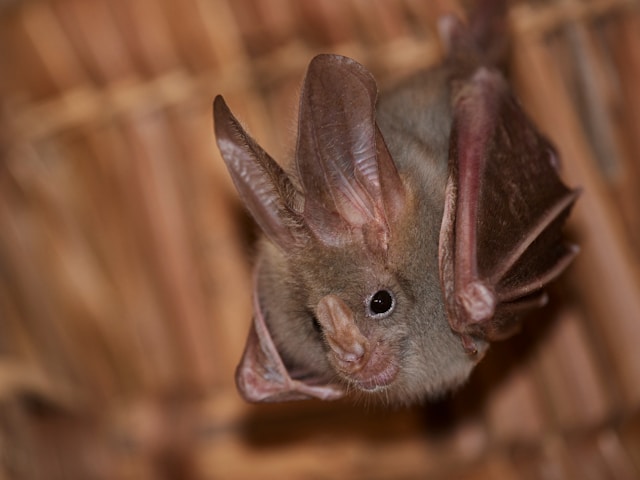
The scientific name of the bumblebee bat is "Craseonycteris thonglongyai". It is the only extant member of the family Craseonycteridae, which holds the title of the world's smallest mammal by body size. Their name also pays homage to their resemblance to a bumblebee, in both size and flight patterns, adding a layer of intrigue to their ecological role. Also known as Kitti’s hog-nosed bat, the bumblebee bat is native to the limestone caves along rivers within the dry evergreen or deciduous forests of western Thailand and southeastern Myanmar.
However, the generic name "Craseonycteris" derives from Greek, meaning "thick" and "ear", which aptly describes its notable features, including large ears that enhance its echolocation capabilities. Meanwhile, the species name "thonglongyai" honours a Thai zoologist, Dr Thonglongyai, who played a pivotal role in its discovery, emphasising the bat's cultural significance and the importance of local conservation efforts. It is difficult to study due to its rarity and secretive habitats.
The bumblebee bat, known as Kitti's hog-nosed bat, is a unique and fascinating creature that has captured the attention of many scientists and animal enthusiasts. Here are some interesting facts and features about them:
Bats vary in colour and fur texture, and their facial appearance, dominated by the muzzle and ears, varies strikingly between families and often between genera.
However, the bumblebee bat is a marvel of nature, boasting a diminutive size that makes it one of the world's smallest mammals. Its round, plump body is covered with soft, velvety fur that ranges from reddish-brown or buffy brown to grey on its upper body, with a paler or lighter hue underneath. It has upturned, pig-like pinkish snouts and crescent-shaped nosetrils, which gives it another name, Kitti's hog-nosed Bat. They also have large ears around 9 to 10.2 mm with a tragus about half that length, while their small, dark eyes are mostly hidden by thick facial fur. Additionally, it has strong jaw muscles and a tiny mouth, which housed 28 sharp teeth, equipped with relatively large, long, and narrow upper teeth and lower incisors. The Bumblebee bat also has two forelimbs, two hind legs, long fingers with strong claws, elongated wings, and an absence of a visible tail. Their large web of skin (darker leg membrane) between their hind legs is called the uropatagium, while their forelimbs have evolved into wings (a prominent flight membrane), making them adept fliers. Their wings are black with yellow stripes and broad with pointed tips. The bumblebee bat can fly about 1 km from their limestone caves. Their males can be identified by a large, swollen glandular at the base of their throats, while females possess an extra set of non-functional (vestigial) nipples located near the groin. They can produce up to 220 echolocation calls per second, with a range of 70 to 80 kHz, emitting high-pitched sounds that bounce off objects and return to the source. Despite its fragile appearance, the bumblebee bat showcases remarkable resilience; it can thrive in various environments, from limestone caves to tropical forests.
Informally known as the bumblebee bat, Kitti’s hog-nosed bat is about the size of a large bumblebee, weighs between 1.7 and 2.0 grams in mass and measures 1.1 to 1.3 inches in length. The bat’s small size is a crucial adaptation for evading predators. Their forearms are 22 to 26 mm long and have a wingspan of about 5.1 to 5.7 inches, hence the common name of "Bumblebee bat". It is also about the size of a hummingbird.
The bumblebee bat's anatomy is perfectly adapted to its lifestyle. Its fur provides excellent camouflage among the lush foliage of its Southeast Asian habitat. Bumblebee bats' elongated fingers stretch across their wings and support their delicate flight membranes, enabling nimble hovering and agile flight in dense forests. This specialised wing structure also enables them to hover in place while hunting for insects, allowing manoeuvres as they flit between flowers in search of insects. Its strong legs, small feet, and curly toes with large claws limit its ability to walk and are designed for comfortably perching upside down in limestone crevices, emphasising a life perfectly suited for aerial existence. Unlike most other bat species, it has no visible tail or any tail bones, but it possesses a large uropatagium (web of skin stretching between their hind legs) to help control movements during flight. This bat's small eyes, though not particularly suited for daytime vision, are adapted for low-light conditions, allowing them to thrive in the twilight hours when their insect prey is most active. The bumblebee bat's specialised teeth are adapted for its diet of small insects, allowing it to efficiently capture and consume prey. This bat’s highly specialised echolocation system is finely tuned for detecting tiny insects in the dark, showcasing nature's ingenuity in designing sensory systems. Interestingly, their large ears are not only finely tuned for echolocation, which allows them to detect the faintest sounds of fluttering insects in complete darkness, but also play a crucial role in their social interactions, as they communicate with one another using a series of clicks and trills. Its lightweight skeletal structure enables flight efficiency while still supporting vital organs. This adaptation not only plays a critical role in controlling insect populations and maintaining the balance within its ecosystem, but also plays a vital role in pollination, making the bat an unsung hero of its ecosystem.
Bumblebee bats inhabit a unique niche in the ecosystems of Southeast Asia. They are found primarily in the limestone caves along rivers in western Thailand (such as the Sai Yok area) and southeastern Myanmar. These tiny creatures thrive in tropical forests, where they can easily navigate through intricate cave systems. Bumblebee bats roost exclusively in dome-shaped limestone caves, typically near rivers within dry evergreen forests or deciduous forests and bamboo thickets, where they find shelter and an abundance of insects to sustain their diet. They prefer large, multi-chambered caves near the tops of mountain ranges, where they can cling to the ceilings to retain warmth. These smallest bats navigate through intricate cave systems and dense forests with a specialised echolocation system. They have small home ranges and do not travel further than 1 km from their roost to hunt. Their preference for cave dwellings not only provides safety from predators but also provides a stable temperature and humidity level, essential for their survival and reproductive success.
The distribution of bumblebee bats is remarkably limited. They are homebodies, often restricted to specific microhabitats within their range. Their preference for low-altitude caves means that even minor environmental changes can have profound effects on their populations. Bumblebee bats are found in the Oriental Region of the world. They are primarily located in the Bilauktaung mountain ranges in western Thailand (such as the Sai Yok National Park region of Kanchanaburi), where their populations are highly localised and in the southeastern parts of Myanmar near the Thailand border, where their populations are less documented than the Thai populations.
Due to its small size and specific habitat requirements (localised to a few cave systems), the bumblebee bat is also vulnerable to any disruption, be it through human-led disturbance, such as limestone mining, tourism, cave meditation, deforestation or climate change, which poses a significant threat to their existence. Conservation efforts are critical, not just for the bumblebee bat itself but for the broader ecosystem, as these bats play a role in pest control and pollination.
There are no common types or subspecies of the Bumblebee Bat. It is a single, distinct species of bat, formally known as Kitti's hog-nosed bat. This bat was discovered by the Thai zoologist Dr Kitti Thonglongya in 1974 and named "Kitti's hog-nosed". On the other hand, it also gets its popular name "the Bumblebee Bat" because it is similar in size to a large bumblebee, with flight patterns. However, it is not the sole member of its species, but also the only surviving member of its entire unique family, Craseonycteridae.
While there are no other distinct subspecies of bumblebee bat, researchers have observed minor regional variations in their rapid echolocation calls between the populations found in Thailand and Myanmar.
The bumblebee bat (Craseonycteris thonglongyai) is the smallest mammal (a warm-blooded creature that gives birth to live young) in the world. These diminutive bats, weighing around 1.7 to 2.0 grams and measuring around 1.1 to 1.3 inches in length, resemble a large bumblebee and exhibit a few distinct characteristics. The bumblebee bat has an upturned, pinkish hog-shaped nose and crescent-shaped nosetrils, which gives it another name, Kitti's hog-nosed Bat. It also has large ears around 9 to 10.2 mm with a tragus about half that length, and its small, dark eyes are mostly hidden with thick facial fur. It has strong jaw muscles and a tiny mouth, which housed 28 sharp teeth. Their wingspan is about 5.1 to 5.7 inches, that let them to hover in one place. The Bumblebee bat also has long fingers with strong claws to cling to the cave ceilings. Their upper bodies are covered in reddish-brown or buffy brown or grey fur, with a paler underneath. This bat does not have a visible tail, even though it has two caudal vertebrae. Their large web of skin between their hind legs is called the uropatagium, while their forelimbs have evolved into wings, making them adept fliers. Their uropatagium is rather large, while their wings are broad with pointed tips and are black with yellow stripes. Their males can be identified by a large, swollen glandular at the base of their throats, while females possess an extra set of non-functional nipples located near the groin.
Sociability is another striking characteristic of the bumblebat. This smallest bat inhabits limestone caves within bamboo and dense deciduous forests along rivers, where they form small colonies, averaging 10 to 500 individuals. They roost in caves near the tops for warmth and shelter, which facilitates social interactions and mating. Their social interactions are marked by a series of high-pitched calls, like clicks and trills, which serve both as echolocation aids and as a means of communication among group members. They don't huddle together and maintain personal space high in the cave ceiling, except during the mating season. However, bumblebee bats breed once a year, with mating occurring late in the dry season. Females give birth to a single pup, and the baby remains attached to the mother's pubic nipple during the first few weeks.
The most striking characteristics of bumblebee bats are their remarkable ability to thrive in limestone caves within tropical environments along rivers. These tiny creatures easily navigate their habitat with a specialised echolocation system. Bumblebee bats are nocturnal, and they spend their day in torpor in the dark crevices within the cave. These smallest bats are active during dusk and dawn, but they are most active at dusk. Every day, they only leave their caves for 20 to 30 minutes at dawn and dusk for foraging flights. Bumblebee bats can not fly more than 1 km away from their limestone caves in search of food. They fly in the upper canopy and along the tops of bamboo clumps and deciduous or evergreen dry forests for hunting and feeding. They use rapid echolocation to find insects, which clicks up to 220 times per second, with a range of 70 to 80 kHz. Bumblebee bats are known to snatch their prey using their mouths by hovering in the air like a hummingbird. They feed on small insects such as flies, mosquitoes, beetles, spiders and moths. These smallest mammals have sharp teeth and strong jaw muscles to crush their prey. This ability not only highlights their sophisticated sensory adaptations but also underscores the crucial role they play in maintaining the ecological balance by controlling insect populations. Unfortunately, habitat destruction and human encroachment pose significant threats to their populations, making conservation efforts critical.
The bumblebee bats are found in the Oriental Region of the world and live in limestone caves along rivers within dry evergreen or deciduous forests of western Thailand and the southeastern Myanmar border. They also live in bamboo forests where they forage for insects in the upper canopy. These bats have very small home ranges, ranging only about 1 kilometre from their roost to hunt. Their echolocation system also allows them to navigate and hunt in the dense forests of Southeast Asia. They roost in dark, secluded areas, which not only provide safety from predators but also provide abundant insect populations and maintain humidity levels crucial for their survival.
Bumblebee bats are insectivorous, meaning they primarily eat insects. They feed on small insects such as mosquitoes, flies, wasps, beetles, spiders, barklice and moths. This smallest bat only needs to eat a few insects to be full. They live in tropical climates and are active only at dawn and dusk for extremely short feeding sessions lasting just 20 to 30 minutes. When they are not active, they are thought to enter states of torpor, and they spend their day in torpor, reducing their movement, body temperature and metabolic rate to save energy. However, bumblebee bats are nocturnal, and they are most active at dusk when they fly in the upper canopy and along the tops of bamboo clumps and deciduous or evergreen tropical forests for hunting and feeding. Due to their tiny size, bumblebee bats require an abundant supply of insects and have a very short flight range.
Bumblebee bats typically do not travel further than 1 km from their roost in search of food, and they have a very unusual way of hunting insects. Bumblebee bats use rapid echolocation to find insects in the dark, which clicks up to 220 times per second, with a range of 70 to 80 kHz. These smallest bats are known to catch their prey using their mouthparts while in flight. They rely on a combination of rapid wing beats (hover in mid-air) and agility to snatch insects mid-flight, showcasing impressive aerial acrobatics that belie their size. Bumblebee bats have sharp teeth and strong jaw muscles to crush their prey's exoskeletons. Interestingly, they play a crucial role in their ecosystem as both predator and prey. Consuming vast quantities of insects, it helps maintain the delicate balance of its environment, controlling pest populations that could otherwise threaten local flora and fauna, while also aiding in pollination.
Changes in climate and environmental degradation can disrupt the availability of these food sources, making survival increasingly precarious. Furthermore, as an insectivore, this smallest mammal plays a crucial role by helping control insect populations and aiding in pollination, contributing to the balance of local ecosystems.
The bumblebee bat, also known as Kitti's hog-nosed bat, is a fascinating creature that showcases an array of intriguing behaviours and lifestyle adaptations. These bats are highly localised and primarily live in a few limestone cave systems along the rivers within dry evergreen or deciduous forests of the Thailand-Myanmar border. They spend their day in torpor, reducing their movement, body temperature and metabolic rate to save energy. Bumblebee bats are active during dusk and dawn, but they tend to be active longer at dusk than at dawn. Every day, these smallest bats only leave their caves for 30 minutes in the dusk and 20 minutes at dawn for foraging flights. They have a very short flight range, up to 1 km/h. So, they do not fly more than 1 kilometre away from their caves in search of food. Interestingly, bumblebee bats have developed a highly specialised echolocation system that allows them to navigate through the dense bamboo and teak canopies near their caves. Their calls are among the highest-frequency sounds produced by any bat, enabling them to detect even the slightest movements of their prey and hunt with precision in the dimly lit caves and dry evergreen forests, where they are found. Bumblebee bats normally forage in the upper canopy and along the tops of bamboo and deciduous or evergreen forests for hunting and feeding on insects. They use their mouthparts to snatch their prey with agility by hovering, allowing them to pluck insects off foliage or catch them in mid-air. This specialisation highlights a remarkable evolutionary strategy, as they play a crucial role in controlling insect populations. Moreover, their nocturnal activities provide an essential service to ecosystems, ensuring balance in the delicate web of life during the twilight hours when most predators are on the prowl.
Moreover, bumblebee bats are harmless. They don't have stings like bees, but they carry diseases such as Coronaviruses and Rabies. These diseases are not a danger to humans unless people come into contact with bad blood or saliva. Researchers have observed that when disturbed, these bats display remarkable agility, darting quickly into crevices to evade predators, underscoring their resilience despite their diminutive size.
Socially, bumblebee bats exhibit a unique communal lifestyle. They prefer small family groups (colonies), which are almost always found in caves located near rivers, reflecting their unique ecological niche. Bumblebee bats often form roosting groups, ranging from 10 to 500 individuals, inside deep limestone caves or dense foliage. Some caves contain small colonies averaging around 100 individuals, but these are rare. Their choice of habitat is not merely for protection, but also reflects their social structure as they often roost closely together, engaging in mutual grooming and vocalisations that strengthen their communal bonds. They communicate with one another using a series of clicks and trills. These groups facilitate social learning, as younger bats observe and mimic the experienced hunters among them. The interplay of warmth and social bonding in these close-knit communities is essential, especially given their vulnerability to environmental changes. They don't huddle together and maintain personal space high in the cave ceiling, except during the mating season. However, bumblebee bats breed once a year, with mating occurring late in the dry season. Females give birth to a single pup, and the baby remains attached to the mother's pubic nipple during the first few weeks, or is left in the roost while she hunts. Interestingly, mothers form small roosting groups, sharing the responsibility for nurturing the young and fostering social bonds among the bats. This solitary nature may allow them to minimise competition for food, as they expertly navigate through dense foliage in search of tiny insects, their primary diet. They are nocturnal and spend their day in torpor in the dark crevices within the cave. Bumblebee bats are most active at dusk, when they fly along the top of bamboo clumps and teak trees to hunt and feed on insects. Preferring habitats with abundant water sources, these bats rely on high-frequency calls (rapid echolocation) that click up to 220 times per second (a range of 70 to 80 kHz) to locate prey in the dark with astonishing precision through dense forests. They primarily consume small insects, such as flies, mosquitoes, beetles, wasps, barklice, spiders, and moths, which they skillfully hunt using their mouthparts with agility by hovering in mid-air. This remarkable ability not only aids in hunting but also highlights their intricate relationship with the ecosystems they inhabit.
As they rely on specific ecological conditions and are so localised to a few cave systems, scientists consider them highly vulnerable. Any disruption, be it through human-led disturbance, such as limestone mining, tourism, cave meditation, deforestation, or climate change, poses a significant threat to their existence. Conservation efforts are critical, not just for the bumblebee bat itself but for the broader ecosystem, as these bats play a role in pest control and pollination.
The reproduction of the bumblebee bat is a fascinating aspect of its biology that highlights the delicate balance of its existence. Females can start reproducing at 18 months old, and they reproduce slowly. These tiny mammals breed once a year, usually mate in late winter or early spring when insects are plentiful. Mothers typically give birth to a single offspring, known as a pup, after a gestation period of about 50 to 60 days. Their births commonly occur between late April and early May. This low reproductive rate highlights the delicate balance of their ecosystem, and each pup plays a crucial role in maintaining the population.
The pups are born tiny, hairless and with their eyes closed. They weigh only about 1 to 2 grams, roughly the same as a bumblebee, which gives rise to their enchanting name. What sets them apart is not just their size but also the nurturing bond that forms between mother and offspring. The babies are raised in nursery caves, where mothers care for their pups diligently, and pups crawl to their mother’s nipples to feed. While mothers forage and roost, pups cling tightly to their mother’s waist until their wings develop enough to fly. Pups grow quickly, and mothers form communal roosts where they often leave their young for warmth and protection when they forage for insects at twilight, returning frequently to nurse and protect them. Pups will learn to fly within a few nights, around 6 to 8 weeks of age, and become fully independent from their mother within a year. This delicate stage in their lifecycle is crucial, as the survival of the pup hinges on the mother's foraging skills and the availability of insects in their habitat.
The lifespan of the bumblebee bat adds another layer of intrigue to its existence. While many small mammals face high mortality rates, these bats can live between 5 and 10 years in the wild, assuming they evade predators and environmental hazards. Their longevity is partly attributed to their ability to thrive in specific habitats, such as limestone caves within dense forests, where they can find shelter, warmth, and ample food sources like insects. Due to their slow reproductive cycle, these smallest bat populations are highly vulnerable to environmental disturbance, such as habitat degradation and the annual burning of forests near their limestone cave homes. However, the interplay between their reproductive strategies and lifespan highlights a delicate balance in nature, showcasing how even the smallest creatures play significant roles in their ecosystems.
The bumblebee bat, one of the smallest mammals on the planet, faces no formally documented natural predators and threats due to its extremely tiny size and highly secretive, nocturnal nature. They are preyed on by a variety of small and opportunistic predators, including snakes (tree-dwelling snakes), birds of prey (many species of owl), squirrels (tree-dwelling squirrels), lizards (arboreal lizards and large monitor lizards), cats (domestic and wild cats), and even larger bats (certain larger carnivorous bat species or the false vampire bat) are known to prey on smaller or bumblee bats, which have honed their skills to exploit the bumblebee bat's diminutive size. In addition to traditional predators, the bumblebee bat contends with the burgeoning threat of invasive species that outcompete native fauna for food and space. For instance, the encroachment of non-native insects can diminish the availability of their primary food source, tiny insects like gnats and midges. As these predators become more prevalent due to environmental shifts, the bumblebee bat's survival hinges on its ability to navigate an increasingly hostile world.
While these natural threats are significant, they pale in comparison to the human-induced challenges that loom larger over their populations. Their survival is threatened primarily by human-driven habitat destruction, cave disturbances, forest fires, and climate-related disruptions. Habitat destruction due to deforestation for urbanisation, agricultural expansion, logging, and limestone mining has led to a drastic reduction in their roosting sites and foraging grounds, making it increasingly difficult for these tiny bats to find shelter, food and safety. Additionally, anthropogenic factors such as urbanisation and agriculture not only fragment their habitats but also introduce pollution that can have dire health implications. This species of bat is also threatened by human disruptions both inside its roosting caves and in the forests where it forages. Conservationists say that monks use the limestone caves for meditation, drug users hiding in caves, and tourists are driven by the desire to explore the roosts, have all negatively impacted the species, disrupting bat colonies, and forcing the sensitive bats to abandon their shelters. Their colonies are small, localised, and females have only one pup per year; these disturbance significantly impact their population stability.
On the other hand, the seasonal burning of forests around their cave systems in Thailand-Myanmar border is a major localised threat, which destroys their vital foraging environments and kills off the insects they eat, impacting their survival rates and reproductive success. Another often-overlooked threat is the impact of pesticides; as these chemicals permeate their environments, they not only reduce food sources but also pose direct risks to the bats themselves.
Furthermore, climate change also poses an insidious threat, altering the ecosystems that support the insects upon which bumblebee bats feed. Heavy rain or sudden temperature drops easily disrupt their hunting and impact their survival, because they have incredibly short feeding windows (only 20 to 30 minutes at dusk and dawn). The delicate interplay between these threats emphasises the need for conservation efforts that protect not only the bumblebee bat but also the intricate web of life it is a part of.
The bumblebee bat stands as one of the smallest mammals on Earth, with a weight comparable to that of a large bumblebee. They are highly localised, living exclusively in the limestone caves along the rivers within the dry evergreen or deciduous forests of the Thailand-Myanmar border. However, their population is a fascinating testament to the fragility of ecosystems. The bumblebee bat has an estimated total population of around 1,200 to 10,300 individuals between 1997 and 2008, while other organisations, like Earth's Endangered Creatures, report smaller estimates ranging from 200 to 2,000 individuals, and The Animal Files places the number closer to 4,000 individuals. Their population is declining, and the species is considered "vulnerable" by the IUCN Red List and "endangered" by the U.S. Endangered Species List.
The total population may be considerably higher, however, with researchers estimating the Thai population at around 45,000 individuals in 2009. While many caves contain only 10 to 15 individuals, the average group size is 100, with a maximum of about 500. Recent studies indicate that their numbers have plummeted due to habitat destruction (such as deforestation and limestone mining), human-led disturbance (such as tourism and cave meditation), and climate change, making conservation efforts more urgent than ever. The delicate balance of their cave environments is not just crucial for the bats but also for the myriad species that share their habitat.
The bumblebee bat, known as Kitti's hog-nosed bat, is the world's smallest mammal. Despite their small size and limited range, bumblebee bats play an important role in their ecosystem.
The bumblebee bat can carry diseases such as Coronaviruses and Rabies. But these diseases are not a danger to humans unless people come into contact with bad blood or saliva, a rare occurrence in the U.S. Rabies can be contracted from almost any mammal, but is commonly reported in bats.
The bumblebee bat is a marvel of nature that often goes unnoticed in the bustling atmosphere of a zoo. With its diminutive size, about the length of a thumb, this tiny creature captures the imagination of visitors who stumble upon its enclosure. Unlike larger bats that might evoke fear or fascination due to their wingspan, the bumblebee bat invites curiosity with its delicate features up close, from its translucent wings to its oversized ears and quirky, pig-like pinkish snout to peculiar flight patterns as they flit around their enclosures, showcasing a blend of agility and grace that belies their size. Observing this rare species in a zoo setting offers an intimate glimpse into their unique behaviours, such as their remarkable echolocation abilities and intricate social interactions, grooming and hanging closely together, which highlight their complex social structures.
At the zoo, their habitat is often designed to mimic the limestone caves and bamboo thickets of Southeast Asia, where they naturally reside. This carefully curated environment allows guests to witness their nocturnal activities, as these bats hover about in search of insects, an essential part of maintaining ecological balance. Zookeepers educate visitors about their role in ecosystems, emphasising how they contribute to pest control by feasting on insects that could otherwise disrupt local agriculture and pollination despite their small stature. Moreover, zookeepers frequently share insights about its conservation status, emphasising that the bumblebee bat is vulnerable due to habitat loss, mining, tourism, human disruptions and climate change. Through these engaging encounters, visitors leave with a deeper appreciation for the delicate interplay of ecosystems and the urgent need to protect such extraordinary species from extinction.
The bumblebee bat, scientifically known as "Craseonycteris thonglongyai", is a single, distinct species of bat. It is not the sole member of its species, but it holds a unique position in the mammalian classification system as the only surviving member of its entire unique family, Craseonycteridae. This tiny creature, often referred to as Kitti's hog-nosed bat, is not only one of the smallest bats but also one of the smallest mammals in the world. The bumblebee bat weighs less than a penny, just 2.0 grams and measures only about 1.3 inches in length. Its classification within the order "Chiroptera" emphasizes not only its bat lineage but also highlights a fascinating divergence from other bat families appromaximately 33 million years ago, with distinct morphological traits that aid in its survival, including its pig-like snout and diminutive size, suggesting adaptations to a specialized ecological niche, primarily feeding on tiny insects, such as gnats, flies and mosquitoes, in the lush forests of Thailand and Myanmar border.
Recent transcriptome-based analyses classify the bumblebee bat under the suborder Yinpterochiroptera, which encompasses Old World fruit bats and various insectivorous bats. This suborder split from the Yangochiroptera (the other major bat group) roughly 63 million years ago.
Evolutionarily, the bumblebee bat presents a compelling case study in biogeography and adaptation. Fossil records trace their lineage back to ancient times, revealing a history marked by climatic shifts and habitat changes that influenced their survival strategies. Unlike other bats, the bumblebee bat has developed a unique echolocation system that allows it to navigate and hunt insects in dense foliage, showcasing an extraordinary evolutionary response to its environment. Its wide, long wings allow it to hover and forage efficiently among the upper canopies of bamboo clumps and teak trees, a key survival mechanism given its fast energy burn rate. As environmental changes continue to threaten their habitats, understanding the bumblebee bat's evolutionary history becomes crucial for conservation efforts, reminding us that even the smallest creatures play significant roles in maintaining ecological balance. This diminutive bat not only captivates with its size but also serves as a poignant reminder of the delicate interconnections that define our natural world.
The bumblebee bat, one of the world’s smallest mammals, has sparked a unique relationship with humans that intertwines conservation efforts and cultural fascination. Found primarily in the limestone caves along rivers within dry evergreen or deciduous forests along the Thailand-Myanmar border, these tiny bats have become symbols of biodiversity and the urgent need for habitat preservation. As human encroachment threatens their limestone cave homes, local communities are increasingly stepping up to protect these remarkable creatures. Conservation efforts are becoming increasingly vital, as local communities begin to recognise the ecological importance of these bats. By fostering awareness through educational programs, villagers can learn how protecting the bumblebee bat not only aids biodiversity but also promotes healthier ecosystems that benefit agriculture, pest control and pollination.
The bumblebee bat's unique characteristics have sparked curiosity among researchers and wildlife enthusiasts alike. They have observed that when disturbed, these bats display remarkable agility, darting quickly into crevices to evade threats. Additionally, bumblebee bats are also totally harmless. They don't have stings like bees, but they can carry diseases such as Coronaviruses and Rabies. However, these diseases are not a danger to humans unless people come into contact with bad blood or saliva. This has led to initiatives that blend conservation with tourism, allowing people to observe these fascinating creatures in their natural environments. Such endeavours can create economic incentives for local populations to prioritise wildlife preservation over land development.
As people engage with the bumblebee bat, they often find themselves drawn into the broader narrative of environmental stewardship, recognising that preserving such delicate species is essential for maintaining the balance of our shared planet. This evolving relationship showcases how appreciation for a species can inspire proactive measures to safeguard habitats, turning once-feared creatures into symbols of hope and resilience in our changing world.
The conservation status of the bumblebee bat (Craseonycteris thonglongyai) is a stark reminder of the fragility of our planet’s ecosystems. Also known as Kitti’s hog-nosed bat, the bumblebee bat is globally classified as "vulnerable" to "endangered" due to its highly restricted geographic range and specific habitat dependencies. As one of the smallest mammals in the world, this diminutive bat faces significant threats due to habitat destruction (such as deforestation, limestone mining, and logging), human-led disturbance (such as tourism, cave meditation, and hunting), and climate change. While it is listed as "endangered" by the U.S. Endangered Species List, the conservation status of bumblebee bats is also "vulnerable" or "near threatened" on the IUCN Red List due to its restricted habitat range and small population numbers. Found primarily in the limestone caves along rivers within dry evergreen or deciduous forests along the Thailand-Myanmar border, the bumblebee bat relies heavily on specific environments for roosting, hunting and breeding.
The major threats to its survival are human disruptions both inside its roosting caves and in the forests where it forages, including tourism, cave meditation, and hunting. Conservationists say that tourists are driven by the desire to explore the roosts, monks use the limestone caves for meditation, and drug users hiding in caves have all negatively impacted the species, disrupting bat colonies and forcing the sensitive bats to discard their shelters. Their small colonies are localised, and females have only one offspring per year; these disturbance in their roosting caves significantly impact their population stability, making recovery particularly slow. These bats are also hunted for local consumption or to sell as souvenirs, which has led to a population decline. Unfortunately, deforestation, limestone mining, and logging in the surrounding foraging areas are leading to the destruction of many of its natural habitats, pushing this species closer to the brink. In addition to habitat degradation, they are also vulnerable to the impacts of climate change, which can alter food availability and disrupt their delicate breeding cycles.
Conservation efforts are essential not only for protecting this unique species but also for maintaining the ecological balance in its native habitats. Innovative conservation strategies are emerging, from community-based initiatives to promote sustainable land use and biodiversity protection. The development of ecotourism initiatives can raise awareness about the importance of preserving bumblebee bat habitats while generating income for local communities, but it may be too late for some of them. By engaging local populations and fostering a sense of stewardship for their environment, there is hope for creating a more sustainable future for this unique species. The survival of the bumblebee bat is not just about saving a single species; it reflects broader ecological narratives that highlight the interconnectedness of all life forms and the urgent need for holistic conservation approaches.
The bumblebee bat, also known as Kitti's hog-nosed bat, is a fascinating creature that contrasts sharply with the colourful insect we know as the bumblebee.