
Bushbabies are small, nocturnal primates endemic to the forests of sub-Saharan Africa. They are famous for their cat-like appearance, loud, crying vocalisations, exceptional jumping abilities, and saucer-like eyes. Bushbabies get their name from their characteristic high-pitched calls, which sound like a human baby’s cry. These tiny African primates are also called "Galagos", and in Africa, a bushbaby generally refers to any of the tiny nocturnal primates of the genus Galago. They are also known as the nagapies, meaning "monkeys of the night".
Bushbabies can be found in various habitats, from dense forests to open savannahs. They are highly adapted to life in the trees, where they spend most of their time. These tiny primates are active at night and sleep during the day in hidden tree hollows or leafy nests that they build in trees or other sheltered places. Bushbabies communicate with each other through a complex combination of loud calls, scent markings and physical grooming. They are omnivorous and primarily eat insects, fruits, and sticky, thick gum that seeps out of trees. Bushbabies' large, round eyes and bat-like ears allow them to see and hear well in the dark. They are ace jumpers and climbers, using their powerful hind legs, specialised grips, and long tails to spring great distances across the forest's canopy. These tiny nocturnal primates are agile climbers and can leap over 6.5 feet from a stationary position. Their fur is also adapted for life in the trees, providing camouflage and insulation from the cold.
However, this small primate species probably helps control insect populations, serves as a seed disperser for many plants, and may also play a part in pollination. Bushbabies' unique foraging behaviours contribute to the health of forests by ensuring the survival of various plant species that depend on them to propagate. Unfortunately, they are threatened by wildfires and habitat loss due to deforestation and urbanisation. But their biggest threat comes from humans. Bushbabies are often hunted for their fur and are also captured for the pet trade. As a result, bushbaby populations are declining in many areas of Africa.
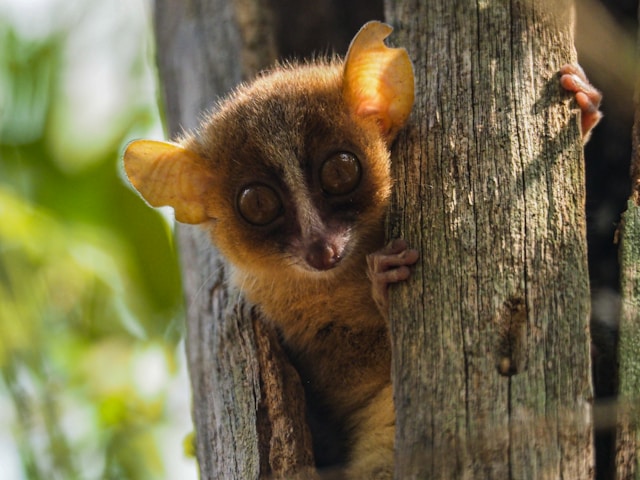
Bushbabies, also known as the Galagos or nagapies. While Galago refers to the same animals as bushbaby, nagapies means "night monkeys" or "little night monkeys" in Lingala, a language spoken in South Africa.
However, the scientific name for the bushbaby is Galagidae. There are over 20 distinct species of these small nocturnal primates that share certain characteristics, such as soft, thick fur, enormous eyes, large, collapsible ears, long hind legs, and long tails, which belong to the family Galagidae and are divided into several main types and genera, including:
So, the scientific name for the bushbaby varies depending on the exact species. For instance, the scientific name of the Senegal Lesser Bushbaby is "Galago senegalensis". The genus name "Galago" comes from the Wolof language term 'galago', which means "monkey", while the species name "senegalensis" references the West African country of Senegal.
On the other hand, the scientific name of the Brown Greater Galago is "Otolemur crassicaudatus", which combines Greek and Latin roots. From the genus "Otolemur", the "Oto" is derived from the Greek word 'ous', which means "ear" and "lemur" is derived from the Latin word 'lemures', which means "ghosts" or "phantoms". Together, the genus name "Otolemur" translates to "eared-lemur". In the species name "crassicaudatus", the "crassi" is derived from the Latin word 'crassus', which means "thick", and "caudatus" is derived from the Latin word 'cauda', which means "tail". Together, the species name translates to "thick-tailed", describing the animal's bushy, heavy tail.
Additionally, Bushbabies also belong to the order 'Primates' and suborder 'Strepsirrhini', which also encompasses lemurs and lorises. But these tiny nocturnal primates are highly arboreal (tree-dwelling), and they typically live in dense forests where they can find plenty of food, safe places to sleep and protection.
Bush babies are small, nocturnal primates that live in Africa. Here are some incredible facts and features about them:
Bushbaby is a tiny, nocturnal primate native to Africa. They got their name from their characteristic high-pitched calls, which sound like a human baby's cry, including complex vocalisation and chatty "mewing". Bushbabies are adorable mammals that look like small cats. They have thick, soft, woolly fur that is grey or brown to reddish-brown or yellowish-brown, with white bellies. They have large, saucer-like eyes, large, bat-like or radar-like ears, long hind legs with rounded fingernails and long tails. Bushbabies have a specialised lower set of teeth called "toothcomb". Their fingers and toes have flat disks of thickened skin, and they possess a specialised pointed claw on their second toe called the "toilet claw". These tiny nocturnal primates are agile climbers and can jump high into the air.
They range in size from cat-sized to mouse-sized. Bushbabies are about 5 to 14 inches long, their tail length is about 6 to 18 inches, and they weigh between 70 gm to 1.8 kg, which can vary among different species. For instance, the lesser bush baby is a small primate that's about the size of a squirrel. Their head-to-body length is about 5 to 6 inches with a tail about 4.3 to 11 inches long, and weighing between 95 and 300 grams. On the other hand, the thick-tailed bushbaby or the brown greater galago is the largest. Their head-to-body length ranges from 11.6 to 14.6 inches, tail length is about 16.3 to 18.6 inches, and their weight is between 1.2 and 1.5 kg, though some weigh up to 1.8 kg. Body size is sexually dimorphic, with males being significantly larger than females.
When it comes to their anatomy, bushbabies can rotate their heads nearly 180 degrees to see in all directions and to spot predators. Along with their big eyes, which help them see in low light, bushbabies are adapted to nocturnal life with their large, collapsible ears that rotate independently like radar dishes to zero in on the sounds of moving insects in the dark and can hear tones as high as 70 kc/s. They can also fold their ears back to protect them when they leap through trees. Bushbabies have a good sense of smell, so they can track prey by scent alone. They have a special "sixth sense" that allows them to detect predators even when they can’t see or hear them. Bushbabies harvest tree gums that seep from trees, using a specialised lower set of teeth called a "toothcomb" in their lower jaw. Their powerful hind legs and elongated ankles, which are powered by strong muscles and elastic tendons, give them the ability to leap long distances across the forest's canopy, up to 7 feet or 12 times their body length in a single bound, and their long tails are used for balance to help them leap from branch to branch in trees. Bushbabies' hands and feet have thickened skin pads that provide a secure grip on smooth branches. Interestingly, the "toilet claw" on their second toe is used exclusively for grooming, and their fur is also adapted for life in the trees, providing camouflage and insulation from the cold. They have varied vocalisations and can make a wide range of noises, from high-pitched screeches to trills that echo through the night air, with chirps and clucks to shrill whistles and squawks or chatters, which they use to communicate with each other.
Bushbabies are native to sub-Saharan Africa. They thrive in a variety of habitats, including moist, dense rainforests, arid savannahs, open deciduous woodlands, thronbushes, riverine bushes and scrublands. Bushbabies can also be found in some urban areas. Most bushbabies live in areas under 2,000 meters in elevation, though some thrive in highland forests up to 2,000 meters. But some species, such as Thomas's bushbabies, inhabit both lowland and montane highland forests at elevations reaching up to 2,000 meters. Their habitat is mainly woodland, where they live in trees almost their entire lives, providing shelter and a rich supply of insects, fruits, tree gums and resins, which make up the bulk of their diet. They rely on tree hollows or the forks of branches in the canopy and creepers, which they use for shelter and nesting, with specific habitat preferences varying by species. They are highly arboreal, using their hind legs for leaping and climbing, and use their long tails for balance to spring great distances across the forest's canopy.
However, bushbabies are broadly distributed across the African continent south of the Sahara, from Central Africa to Southern and Eastern Africa, with their exact range determined by the species. For instance, Senegal bushbabies are a highly widespread species, stretching from Senegal in the west across the Sahel in the east through central Africa to eastern Africa, while Mohol bushbabies are broadly found across much of southern Africa, including Namibia, Botswana, Zimbabwe, and northeastern South Africa. But Dwarf bushbabies are found in the coastal forests of East Africa, including Kenya, Tanzania and Mozambique, and on islands like Zanzibar and Pemba. On the other hand, Greater bushbabies are found across dense forests and drier savannahs in Eastern and Southern Africa.
There are over 20 recognised species of bushbabies found in Sub-Saharan Africa. They are divided into several main types and genera, all of which are classified in the family Galagidae. The major types and their most notable subspecies or related species include:
The Lesser bushbaby is the most common species of bushbaby. It generally refers to the northern lesser galago, but the term "lesser bushbabies" encompasses a broader group of species within th "Galago" genus. Lesser bushbabies mostly inhabit thornbushes, savannahs, and woodlands across Sub-Saharan Africa, from Senegal east to Somalia and down to South Africa. They have large, round, saucer-like eyes, large, bat-like or radar-like ears, powerful hind legs and long tails. These small, nocturnal primates have woolly thick fur that ranges from silvery grey to dark brown. They are 5 to 6 inches in length with a tail of about 4.3 to 11 inches and weigh 95 to 300 grams, about the size of a squirrel. Lesser bushbaby get their name from their high-pitched calls, which sound like a human baby’s cry. These species make complex vocalisations, including chirping, clucking and chatty "mewing" sounds to communicate with other members of their group. They let out shrill whistles, squawks, or chattering bursts in danger to alarm their troop and deter predators. Lesser bushbabies eat small insects (grasshoppers, beetles, moths, and scorpions), which they catch by leaping and gleaning from vegetation. They also feed on tree gums that seep from trees, which they harvest using a specialised lower set of teeth called a "toothcomb", and consume seasonal fruits, seeds, nuts, nectar, and flowers. Lesser bushbabies live around 2 to 4 years in the wild and can live up to 14 to 16 years in captivity, which differs drastically depending on their environments. The recognised species include:
The Greater galago, also known as the Thick-tailed Bushbaby, is the largest of all bushbaby species, with a head-to-body length of 9 to 19 inches, a tail length of 11.4 to 21.5 inches and a weight of 0.5 to 2kg. Males are typically larger and heavier than females. They are known for being the most social of the Galagos. Unlike smaller bushbabies that leap long distances, the thick-tailed bushbaby moves by walking, running and climbing heavily through the branches. They are primarily nocturnal, arboreal foragers that eat fruits, seeds, flowers, tree gum, and insects. Thick-tailed Bushbabies are native to Eastern Africa to Southern Africa, ranging from Kenya and Tanzania down to South Africa. They can live for 15 to 18 years in the wild, while captive individuals can reach up to 22 years of age. Its recognised species include:
The Eastern Dwarf Galago is found in East and Southeast Africa and lives in coastal forests, thickets, and mountains. They are tiny, large-eared, wide-eyed strepsirrhines (with the Rondo dwarf galago weighing less than 100 grams), often weighing between 60 and 150 grams, making it the smallest of all galagos. Their fur is dense and typically brownish or greyish, providing excellent camouflage in their arboreal habitats. These bushbaby populations stretch from Southern Kenya down through Tanzania and into Northern Mozambique, including islands like Zanzibar, due to their forest habitats, which have become highly fragmented over time, and they are often isolated in small, distinct territories. However, its recognised species include:
The Western Dwarf Galago is native to Western and Central Africa. It is found in dense tropical rainforests and forest edges from Senegal across to western Tanzania, and on Bioko islands in the Gulf of Guinea. They measure only 5 to 6 inches and weigh about 60 to 100 grams, making them some of the smallest living primates. Like other members of their family, western dwarf galagos are solitary and strictly nocturnal. They use highly distinct "crescendo" calls to communicate and locate mates. The recognised species of the Western Dwarf Galago include:
The Needle-Clawed Galago is found in the moist, lowland forests of Western and Central Africa. These agile primates are primarily gummivores, relying on tree gum and sap for up to 75% of their daily meals. They are unique among bushbabies for having keeled nails with needle-like points, which they use to scoop gum and resin from tree bark. Needle-Clawed Galagos are also equipped with an elongated "toothcomb" for scraping bark and highly specialised claws. They measure roughly 21 to 24 cm in body length with a longer tail, and weigh between 260 and 360 grams. Like other galagos, they possess a specialised "toilet claw" on their second toe used exclusively for grooming. Its recognised species include:
The Squirrel Galago is native to the tropical rainforests of Western and Central Africa, ranging from Cameroon and Nigeria to Gabon and Equatorial Guinea. They are easily recognised by their huge eyes, large, sensitive ears, and long, bushy squirrel-like tails. Squirrel Galagos typically have a head-and-body length of 6 to 11 inches with a long, bushy tail of 8 to 12 inches, and weigh between 200 and 455 grams. Their diet consists primarily of fallen fruit, but they will supplement their diet with insects and small arthropods, distinguished by their specialised vocalisations and vertical clinging and leaping abilities. The recognised species include:
Bushbabies are famous for their cat-like appearance, loud, crying vocalisations, and exceptional jumping abilities. They get their name from their characteristic high-pitched calls, which sound like a human baby’s cry. These tiny primates ranged in colour from grey and brown to reddish brown or yellowish brown, with soft, woolly fur. Bushbabies have large saucer-like eyes, which are specially adapted to see in low-light conditions, and large radar-like ears that rotate independently to zero in on the sound of moving prey in the dark. They are also characterised by their powerful hind legs, which give them the ability to leap long distances between trees to capture insects and fruits, up to 7 feet in a single bound, and their long tails are used for balance to help them leap from branch to branch in trees. During this time, they can fold their large bat-like ears back to protect them when they leap through trees. These small primates communicate with each other through a complex combination of vocalisation, scent markings and physical grooming. Bushbabies have a "toilet claw" on their second toe, used exclusively for grooming. They are nocturnal and sleep during the day in hidden tree hollows or leafy nests, spending most of their time high up in a canopy of trees. Bushbabies are omnivores that primarily eat insects, fruit, sticky, thick tree gum and sometimes small arthropods. They scrape and extract nutrient-rich, sticky, thick gum from tree barks, using a unique "toothcomb" in their lower jaw. Bushbabies have a lifespan of over 16 years in the wild. This small primate species helps control insect populations, serves as a seed disperser for many plants, and may also play a part in pollination.
Bushbabies, also called galagos, are any of more than 20 species of small, attractive arboreal primates that live on the continent of Africa. These small, nocturnal primates are found throughout the forests, woodlands, savannahs, and bushlands of sub-Saharan Africa, ranging from Senegal across to the west, through East Africa, down to South Africa.
Bushbabies are omnivores, and their exact diet varies by species and location. These small nocturnal primates' diet consists mainly of small insects, fruits, and tree sap (sticky, thick gum) that seeps out of certain tree species. Bushbabies are voracious insectivores that consume large numbers of grasshoppers, beetles, moths, caterpillars, termites, and scorpions. As opportunistic feeders, most bushbabies also feed on seasonal vegetation, like flowers, berries, seeds, leaves, nectar, nuts, and grain, while larger species of bushbabies are supplemented by lizards, small reptiles, rodents, frogs, small birds, and eggs. Bushbabies get most of their hydration from their food and rarely need to drink directly from water sources.
Bushbabies are nocturnal hunters that are active at night as they search for food and sleep in trees or bushes during the day. They rely on their large, bat-like ears with keen hearing to locate their prey, which rotate independently like radar dishes to zero in on prey in the dark, while their big eyes help them see in low light. Once Bushbabies spot their target, they pounce on it with lightning speed. Their powerful hind legs give them the ability to leap long distances, up to 7 feet or 12 times their body length in a single bound, between trees to capture insects and fruits, while they use their specialised grips and long tails for balance to help them leap from branch to branch in trees. They also scrape and extract nutrient-rich, sticky, thick gum from tree barks, using a unique "toothcomb" in their lower jaw.
As nocturnal omnivores, they play a crucial role in their ecosystem by controlling insect populations and acting as vital seed dispersers, supporting both biodiversity and local agriculture, while they also serve as an important food source for larger predators.
Bushbabies are small, nocturnal primates that are very active at night and sleep during the day. They are highly agile tree-dwellers, spending most of their time high up in a canopy of trees. Bushbabies only come down to the ground to travel from one tree to another. When they do come down, they move quickly and quietly so as not to be seen or heard by predators. These pint-sized primates are aptly named for their distinct vocalisations resembling a human baby's cry, including chirping, clucking, shrill whistles, squawks, and chatting sounds. Bushbabies can make 18 different calls that are associated with specific behaviour, and they whistle shrilly in danger. They also communicate through scent markings and physical grooming, using the "toilet claw" on their second toe. They are very shy creatures and spend their day in hidden tree hollows or leafy nests in small communal groups of up to 6 individuals. Unlike other primates, to maintain a grip on branches and mark their paths, bushbabies will urinate on their hands and feet before climbing. They are good climbers and leapers. Bushbabies can leap long distances between trees to capture insects and fruits, up to 7 feet in a single bound, a feat made possible by their powerful hind legs, which, along with their long tails, are used for balance to help them leap from branch to branch in trees. Their unique foraging behaviours also contribute to the health of forests by ensuring the survival of various plant species. Although bushbabies are small, they are very brave and will fight off larger predators if necessary.
Bushbabies live alone or in small groups. They communicate both by calling to each other and by marking their paths with their urine. Males maintain distinct, overlapping territories that they defend and mark using scent glands and urine, while females and their offspring form close-knit social groups, often sharing territories. But males typically leave their mother's territory after reaching puberty. These family groups are equipped with complex vocalisations ranging from high-pitched screeches to trills that echo through the night air in the forests. This vocal communication strengthens social bonds among group members while also serving as a deterrent against potential predators. Bushbabies rely heavily on camouflage during the day, while at night time they search for food and mates. At the end of the night, group members use a special rallying call to gather to sleep in a nest made of leaves or tree branches in a hole or rest high up in a canopy of trees, an adaptation that cleverly conceals them from predators. These tiny primates live in rainforests, savannas and woodlands across sub-Saharan Africa. Bushbabies are gentle creatures that live off an omnivore's diet of insects, fruits and tree saps or gums. They use their unique "toothcomb" in their lower jaw to scrape and extract nutrient-rich, sticky, thick gum from tree bark. Bushbabies help control insect populations and serve as seed dispersers for many plants due to their frugivorous diet. While they may also play a part in pollination, being a potential prey species, they may also affect predator populations. But they are threatened by wildfires and human activities, including habitat loss (deforestation, logging and urbanisation) and the illegal pet trade, often hunted for their fur and also captured for the bushmeat trade.
Bushbabies are relatively solitary creatures, coming together only to mate, and their mating season varies depending on the species. They are polygynous and reproduce twice a year, once in November when the rains begin and again in February when the rains end. Some bushbabies reproduce between July and March, while some give birth between January and February and again between October and November. During mating season, males will follow multiple females and make loud calls in an attempt to impress them. If a female is interested, she will allow the male to touch her fur, and the male will mate with them during their brief estrus (1 to 3 days). Once they have mated, the pair will go their separate ways. This time, mothers construct nests, which are made from leaves or take over uninhabited bird nests or tree hollows to give birth. After a gestation period of about 110 to 120 days, female bushbabies will give birth in litters of 1 to 2 infants.
Young bushbabies are born fully furred with their half-open eyes and are unable to move. After a few days, the mother frequently carries the infant in her mouth or leaves it hidden ("parked") in dense vegetation while foraging. Then, infants will cling to their mother’s fur for the first few weeks of life after birth. The young will start to eat solid food at about 6 weeks old, but will continue to drink their mother’s milk for several months. They are nursed for about 10 to 14 weeks. Young bushbabies develop quickly, with full independence usually reached between 2 and 5 months. When males reach puberty, they leave their natal groups around 9 to 10 months, but females often stay and form social groups with closely related females.
Bushbabies typically live for about 3 to 4 years in the wild due to high predation combined with harsh environmental factors, but can live between 14 and 16 years in captivity with no natural predators, provided consistent medical care and diet.
Bushbabies are small, nocturnal primates native to sub-Saharan Africa that face a variety of natural predators and human-induced threats. In the wild, nocturnal predators highly target bushbabies. Their main predators are owls, arboreal snakes, genets, wild cats, servals, mongooses, civets, foxes, jackals and leopards. These predators can easily kill bushbabies because of their size. Interestingly, chimpanzees have been documented poking sticks into tree holes as "spears" to extract sleeping bushbabies. Other primates, such as grey-cheeked mangabeys and blue monkeys, are also known to opportunistically hunt them.
Furthermore, they have several adaptations that help them avoid predation, including their large eyes, which give them excellent night vision; long ears, which help them hear keenly; long hind legs, which allow them to make quick escapes by rapid leaping; group warning calls; and hiding in tree hollows.
However, bushbabies’ biggest threats come from wildfires and human activities, including habitat loss, exotic pet trade, and bushmeat trade. Their greatest threats are fast-moving wildfires because bushbabies can't travel long distances rapidly on the ground, so they can easily get trapped in the tree canopy and lose their entire food supply. These animals are also threatened by habitat loss, deforestation, logging, and expanding urbanisation, which destroy their natural forest canopy, on which they rely for food and shelter. In addition to these threats, bushbabies are sometimes illegally captured and sold on the black market for the exotic pet trade. They are often hunted for their fur, which is used to make clothing and other items. In some local regions, bushbabies are also hunted and consumed as bushmeat in small numbers. As a result of these activities, bushbaby populations are declining in many areas of Africa.
There is no overall global population estimate for bushbabies or galagos because there are over 20 distinct species spread across sub-Saharan Africa. While an exact global population does not exist, there are some specific species whose populations are known, and the population status varies by species, with some being widespread, while others may be less understood. For instance, the population numbers of the Senegal bushbaby are not tracked, but the species is considered "common and widespread". On the other hand, some specific localised populations of Mohol bushbabies have been recorded living in densities ranging from 20 to 120 individuals per square kilometre in protected habitats, like South Africa's Kruger National Park.
The population has been declining for years and is now at risk of extinction. Bushbabies are important members of their ecosystems. They help to disperse seeds and control insect populations. Unfortunately, due to the decline in bushbaby populations, these important roles may no longer be carried out effectively.
Bushbabies are small, nocturnal primates native to sub-Saharan Africa and play a crucial role in their ecosystems.
Watching bushbabies at the zoo is a captivating experience, as these small, nocturnal primates display an extraordinary blend of agility and curiosity that never fails to intrigue visitors. With their cat-like appearances, large, luminous eyes, bat-like ears, incredible leaping abilities, and loud, crying vocalisations, which sound like a human baby’s cry, bushbabies invite us to glimpse into their world, a realm where the night is alive with sound and movement. Observing them during feeding time reveals their remarkable adaptability; they skillfully swing from branch to branch while snatching insects or fruits and sipping sap or nectar. This behaviour underscores a symbiotic relationship with their environment, reminding us of the delicate balance in nature.
Behind the scenes, zookeepers focus on replicating the bushbaby’s wild diet to ensure optimal health. With specialised feeding practices that include insects and fresh fruits like bananas and mangoes, they provide nutritionally balanced meals that mimic what these primates would find in the wild. Native to African forests, bush babies help control their prey populations as insectivores and play a part in the dispersal of seeds due to a frugivorous diet, but these animals face threats from habitat loss and the illegal pet trade.
At the zoo, educational programs often highlight their roles, enlightening guests about conservation efforts not only for bushbabies but for the entire ecosystems they inhabit. This connection often transforms casual observers into advocates for wildlife preservation as they learn the significance of maintaining biodiversity in our ecosystems. Rather than merely providing entertainment, a visit to see bushbabies serves as an entry point for larger discussions about conservation and human responsibility towards nature's delicate balance. Moreover, breeding programs within zoos aim to ensure the genetic diversity of this species.
Bushbabies, also known as galagos, are small nocturnal primates native to the tropical and subtropical forests of sub-Saharan Africa, famous for a distinctive high-pitched call that sounds like a human baby's cry. There are over 20 different species that exist, falling under the primate suborder 'Strepsirrhini', which also encompasses lemurs and lorisids. They are classified in the family Galagidae, and their classification generally divides them into several genera, including:
Fossil records suggest that the ancestors of modern bushbabies diverged from the lineage of lorises and lemurs over 40 million years ago, leading to an extraordinary variety influenced by ecological factors such as habitat type and food availability. Primitive bushbaby-like primates were once widespread across multiple continents, though modern bushbabies are exclusively African. Within the family Galagidae, there are numerous species which evolved distinctive traits, such as large eyes for excellent night vision, large, rotatable, collapsible ears for hunting fast-moving insects by sound, lightly built and powerful hind legs for a legendary leap that can cover distances up to 7 feet (2.25 meters) in a single bound, long tails for balance, specialised sharp-keeled nails for scraping tree bark or grooming, and toothcomb for extract tree sap or gums. This unique locomotion not only aids in foraging but also plays a vital role in avoiding predators in their dense forest habitat.
Interestingly, their vocalisations offer another layer of complexity; distinct calls help maintain social bonds and territorial boundaries within diverse species. Recent studies suggest that these sounds may even vary by region, hinting at intricate cultural evolution across populations. As sub-Saharan Africa underwent climate shift and formed varied woodland and savannah environments, bushbabies underwent extensive speciation. Because different species look nearly identical, scientists often use their highly specific, distinct nocturnal calls to differentiate them. As researchers continue to explore this lineage through advanced genomic analyses, we gain insights into how these creatures not only survived but thrived amidst varying ecological pressures, reminding us of nature's resilience and ingenuity shaped over millennia.
Bushbabies, with their cat-like charm, saucer-like eyes, bat-like ears and acrobatic prowess, have carved out a unique niche in the human imagination. In some regions of South Africa, these nocturnal primates have found themselves at the intersection of myth and reality, often revered for their agility and playful nature. Their enchanting vocalisations and high-pitched calls, which sound like a human baby’s cry, have led to local folklore that sees them as omens or spirits, weaving them into the fabric of cultural narratives. This mystical allure has inspired numerous conservation efforts aimed at protecting their native habitats from encroaching development.
Bushbabies have historically been perceived as exotic pets or curiosities in wildlife tourism. There’s a growing recognition of their role as indicators of ecosystem health. Observing bushbaby populations can reveal much about habitat conditions and the broader environmental impacts caused by human activity. While these nocturnal primates are naturally shy and elusive, increasing human interaction in some regions has led to unexpected connections.
As urban areas expand into traditional bushbaby habitats, challenges arise, and conflict over food sources occasionally pits humans against these nimble creatures. Yet, innovative wildlife management strategies are emerging that educate communities about sustainable practices while fostering a sense of stewardship toward these remarkable animals.
The bushbaby, a small nocturnal primate endemic to Africa, faces varied conservation challenges that reflect the complexities of its environment. Habitat loss due to deforestation and agricultural expansion has critically reduced their populations in several regions. As these nimble creatures depend on dense foliage for both protection and food, the fragmentation of their habitat disrupts social structures and mating patterns, making recovery all the more difficult.
However, bushbabies vary in conservation status. While some bushbaby species are categorised as "Vulnerable" or "Endangered" by the International Union for Conservation of Nature (IUCN), others remain relatively stable thanks to adaptive behaviours. For instance, most widely distributed species, such as the Senegal and the Southern lesser bushbabies, are listed as "Least Concern" by the IUCN as being "common and widespread" with stable, though uncounted, wild populations. These species are generally adaptable to human-modified landscapes. But some specific species, like the Rondo dwarf galago, are classified as "Endangered" because their population is heavily restricted to isolated coastal forests in Tanzania. On the other hand, the Zanzibar and the Uluguru bushbabies are considered "Vulnerable" because of their highly fragmented forest homes.
Interestingly, urbanisation has driven certain species into human-populated areas where they exploit new food sources, perhaps a testament to their resilience. This adaptability also exposes them to threats such as vehicle collisions and increased predation by domestic pets. To secure a future for these unique primates, conservation efforts must pivot towards not just habitat restoration but also fostering coexistence between bushbabies and expanding human communities.
Bushbabies and lemurs are both primates, but they differ in many ways.