
The eagle is one of the Earth’s most popular and powerful birds. It is known for its majestic beauty, hooked beaks, keen eyesight, sharp claws, powerful wingspan and strength. Eagles are found in many different parts of the world, particularly in North America, Europe, Asia and Africa. There are several species of eagles, each with its unique characteristics. Their diets, habitat preferences and behaviour patterns make them fascinating creatures to explore further. Depending on their habitat, they range in size from small to large. Eagles also have a thick coat of feathers that helps keep them warm during cold weather months. Perhaps one of the most impressive features of eagles is their wingspan, which also ranges from small to large and can reach lengths greater than 8 feet. For example, the Booted Eagle has a wingspan of 4.4 feet and the Wedge-Tailed Eagle, which has an impressive wingspan reaching 7.5 feet, with recorded measurements up to 9.4 feet. Some species can even dive at speeds of up to 160 kilometres per hour. Despite its large size, an eagle can still fly incredibly fast, manoeuvre gracefully through the air with ease and soar high in the sky. Their nests are often found in tall trees or rocky cliffs where they can easily survey their surroundings for potential threats or prey. Eagles typically feed on small mammals, rodents and even larger prey, like deer or goats.
Furthermore, eagles are common symbols that represent strength, courage and freedom. One of the most widespread and recognisable eagles is the Golden Eagle. It is the national bird of several Northern Hemisphere countries. Eagles have been featured on coins, flags and even as national symbols of countries such as the United States of America. Here, another recognisable eagle is the Bald Eagle, which became a symbol of American freedom after being adopted as the national bird in 1782. This species has a wingspan of 5.5 to 7.5 feet and is found across North America. Other notable eagle species are the White-Tailed eagle, the Steller’s Sea eagle and the Harpy eagle, among many others. Each kind has unique features that help it survive in different environments across the Globe.
Eagle or bird of prey
Accipitridae
2.5-3.5 feet long, wingspan 5.5-8 feet
2.5-6.5 kg
14-35 years
Africa, Asia, Central America, Europe, North America, Oceania, South America
The eagle is one of the most revered species of birds in the world, and this bird is divided into two families:
The Accipitridae family includes several species of eagles, such as Bald eagles, Golden eagles, Harpy eagles, Imperial eagles, Steller’s sea eagles, Booted eagles, Serpent eagles, etc, which also includes hawks, kites and vultures, while the Pandionidae family contains only one species, the Osprey.
So, the scientific name for the eagle is "Accipitridae". But different types of eagles belong to distinct genera, and their scientific names vary by both species and genus. "Eagle" is a common name applied to many different genera of large birds of prey within the family Accipitridae. For example:
Additionally, several species of Hawk Eagles belong to the genus "Spizaetus", though some species have been moved to the genus "Nisaetus". Therefore, as the eagles belong to different genera, their scientific name reflects distinct classifications, and they are beloved around the world for their beauty, strength and impressive skills.
Eagles are some of the most impressive birds on the planet. These birds of prey have an extraordinary set of features that make them unique among their peers. Here are a few incredible facts and features about eagles:
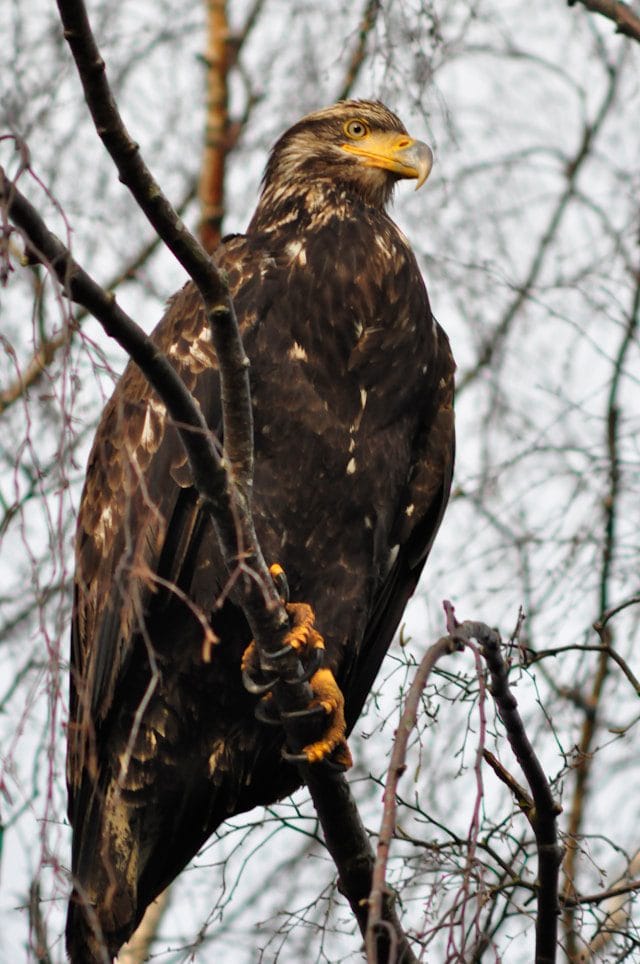
Eagles are one of the most magnificent birds in the world. They can be found worldwide, though some species are restricted to certain regions. An eagle is a large, powerfully built bird with an impressive appearance. They have heavy heads, strong, flexible necks, large, hooked beaks, sharp vision, long, broad wings, strong, muscular legs, and four toes with sharp snatching talons. These birds are easily distinguishable from other birds by their signature size and colouration. While their plumage varies by species, the body and wing feathers of an eagle are generally deep brown, black or grey in colour, and their legs are also covered in scales. For example, adult Bald eagles have a striking white head and tail, but immature Bald eagles are mostly brown with white markings, which helps them blend into their natural environments. On the other hand, Golden eagles have a fully feathered head, with a golden or brown colour to their head and neck feathers, even as an adult.
The size of an eagle varies by species and location; females are generally larger and heavier than males. These large raptors can range from 2 to 3.5 feet long, with wingspans from 6 to over 8 feet, but some species have wingspans up to 9 feet wide. For example, the Golden Eagle is 2.5 to 3 feet long, with a wingspan of 6.2 to 7.5 feet, and females are larger than males, weighing between 3.6 and 6.7 kg, while males weigh between 2.8 and 4.6 kg. On the other hand, the Bald Eagle is 2.4 to 3.4 feet long, with a wingspan of 5.5 to 7.5 feet; some reach almost 8 feet. But the weight of Bald eagles varies by region. Females are generally larger than males, weighing between 2.7 and 6.8 kg. For example, the Bald Eagles in Alaska tend to be larger than those from Southern regions. They can weigh between 2.7 and 4.5 kg for males, and 4.5 and 6.5 kg for females.
Eagles typically weigh anywhere between 2.5 and 6.5 kg, but some species can weigh up to 9 kg. For example, the heaviest is the Steller's Sea Eagle, with some females potentially weighing up to 9 kg and males typically 6.8 kg, with a wingspan of 6.5 to 8.2 feet long and length between 2.11 to 3.6 feet, while others like the Harpy Eagle are lighter, females weighing up to 9 kg and males 5.4 kg, wth a wingspan 6.6 feet long and length between 2.10 to 3.5 feet.
These remarkable birds boast an impressive anatomy, which is built for their predatory life, allowing them to survive in many extreme conditions. Eagles' keen eyesight allows them to spot potential prey from great distances. An eagle's eye is 8 times more powerful than that of a human being, allowing it to see up close as well as 2 to 3 miles away in flight with ease. Their strong, flexible neck bones (14 cervical vertebrae) allow them 270° head rotation to find their food. Eagles' long, broad and strong wings also allow them to reach speeds of up to 160 kph or more when diving for food, as well as soar hundreds of feet off the ground in search of food. Furthermore, powerful chest muscles with hollow and lightweight bones also help them in efficient flight. However, their strong, muscular legs with 4 sharp talons on each foot and a large, powerful hind talon (hallux) allow them to snatch or grasp their prey, possessing crushing strength (around 400 psi). Eagles also have a distinctive hooked beak that helps them kill and tear flesh from their prey with ease. Additionally, the feathers on an eagle’s body, which are specialised for aerodynamics, help it blend into its natural environment to protect it from predators when hunting for food and also help it stay warm during cold weather.
Eagles are a diverse group of birds that thrive in various habitats across the globe. They can be found across continents, ranging from the Americas to Europe, parts of Africa, Asia and Australia. Eagles have a unique habitat preference and inhabit diverse terrains or environments, such as grasslands, farmlands, forests, deserts, swamps, mountains, human-modified landscapes, and open areas, often near water. They also live near large bodies of water such as oceans, rivers, lakes, wetlands, and coastlines for fish. Eagles tend to prefer areas with abundant food and large open spaces, which make it easier to spot prey. Each eagle species exhibits unique adaptations; for instance, the Bald Eagle is found in forests and deserts, but it is frequently found in bayous (like rivers and lakes), and on coasts with abundant fish. The African Fish Eagle flourishes near waterways, and its diet is reliant on fish and waterfowl. The Golden Eagle can be found soaring over mountains, tundra, woodlands and grasslands for nesting and hunting. But some eagles adapt to open plains, farmlands or arid areas, depending on their prey.
This bird usually builds nests in high vantage points like mountains, cliffs, or up in tall, isolated trees near water bodies, where they can have better visibility for hunting purposes. These nests are reinforced annually, becoming huge structures over time. Their nests (aeries) are massive stick platforms, built from large sticks, lined with softer materials like grass, moss, and feathers. These nests are usually 4 to 5 feet wide and 3 to 6 feet deep, but grow larger yearly. Old nests can become enormous, sometimes double the size of new ones, reaching 8 feet wide and 12 feet deep. For instance, the Bald Eagle nests are huge, typically 4 to 7 feet wide, 3 to 6 feet deep, which can grow 10 feet wide and weigh thousands of pounds. A nest in Florida was reported as 9.5 feet wide and 20 feet deep, weighing over 2 tons.
Eagles are found on every continent, except Antarctica, with the highest diversity in Eurasia and Africa, fewer in the Americas, and a few in Australia. Most eagles, over 60 species, live from Europe's woodlands to African savannahs and Asian mountains. However, 2 main species, the iconic Bald Eagle and the widespread Golden Eagle, are found across North America (northern populations migrate and southern populations are resident) from Canada to Mexico. Their range extends across North America, Eurasia (from Europe to Siberia) and North Africa, with a small population in Ethiopia, though very rare visitors like the White-tailed Eagle might appear in Alaska, making them the core eagles for the continent. Additionally, nine eagle species are found in tropical and mountainous regions of Central America and South America, whereas three eagle species, including the White-bellied Sea Eagle, are commonly found in coastal areas of Australia. Eagles can be found in different climates, which are intricately tied to food availability and environmental conditions. These birds are widely distributed in both temperate and tropical climates. For instance, in some parts of the United States, such as Alaska, there is an abundant population of eagles due to their favoured prey, like salmon populations being readily available. But they tend to avoid heavily populated areas due to a lack of food resources.
Eagles' specific distribution also varies by species, though some eagles are migratory, while others remain in the same area all year round. For instance, the North American Golden Eagles are found across North America, while the Booted Eagles are found in Southern Europe, North Africa and Asia, often migrating in the north, sedentary in southern Africa. On the other hand, the Steppe Eagle is a migratory species, travelling vast distances between breeding and wintering grounds, while the Bald Eagle never leaves their general breeding areas because it has access to food sources. They are there year-round, showcasing how natural cycles dictate their movements.
There are around 68 to 70 species of eagles worldwide, belonging to the family Accipitridae. The most common types of eagles are the Golden Eagle and the Bald Eagle. Other types of eagles are the White-tailed eagle, the African fish eagle, the Harpy eagle, the Steller’s Sea eagle and the Wedge-tailed eagle. However, the most widespread eagle is the Golden Eagle.
The Golden Eagle (Aquila chrysaetos) is the most widespread type of eagle found in temperate regions across continents, including North America, Europe, Asia and part of North Africa. It gets its name from the beautiful golden-coloured feathers found on the back of its head and neck. They are typically 2.5 to 3 feet long with a wingspan of 6 to 7.5 feet and weighing between 4.6 and 6.7 kg, but females are larger than males. This bird is known for its powerful flight, soaring through rising air currents and using thermal currents up to 6.44 km high. They have keen eyesight, powerful beaks and talons used for hunting rodents and small mammals. Golden eagle prefers to nest on tall tree tops or cliff ledges, but also nests on scrub or bare ground near open lands. These birds have been used in falconry for centuries, and their golden feathers are used in ceremonies by many native American cultures. The golden eagle is the national bird of several countries, including Albania, Germany, Austria, Mexico and Kazakhstan.
The Bald Eagle (Haliaeetus leucocephalus) is known for its distinctive white head that contrasts with its darker body and has white tail feathers. The name "bald" comes from the Middle English word "blade", which means "white". They are 2.5 to 3.5 feet long, with a wingspan of 5.5 to 8 feet. Females are larger than males and weigh between 3 and 6.3 kg. But the weight of bald eagles also varies by region, and northern birds tend to be larger than southern birds. This bird prefers to nest in old-growth trees, and its nest is huge, can be 10 feet wide and weigh thousands of pounds. Bald eagles live near large water bodies like rivers, lakes, swamps, sea coasts and other open waters where they feed on plenty of fish and other prey also abundant. They are also found in forests, deserts and mountainous regions. Bald eagles are native to North America, ranging from most of Canada to the United States and northern Mexico. They are the national bird of the United States.
Eagles are often hailed as symbols of strength and freedom, and their characteristics certainly reinforce this image. An eagle may resemble a vulture in build and flight characteristics, but has a fully feathered head (often crested) and strong feet equipped with great curved talons. Eagles' most striking characteristic is their exceptional eyesight, which allows them to spot prey from miles away. This acute eyesight not only aids in hunting but also offers a broader perspective on their environment, allowing them to spot potential threats or opportunities from great distances. With eyes capable of detecting ultraviolet light, we see the world through a lens more vivid than our own. Eagles have a powerful soaring ability. Unlike many birds that flap incessantly to maintain altitude, eagles use thermal updrafts to glide effortlessly across vast distances and conserve energy. Their formidable wingspans serve dual purposes: they aid in hunting while also fostering an elegant grace mid-flight, inviting observers to reflect on the beauty found within such power. Moreover, their powerful talons are designed for grasping and carrying prey, while their strong beaks are designed for tearing up flesh, reflecting an evolution finely tuned for specific predatory demands. These birds are tenacious and fearless. Eagles subsist mainly on live prey. They never eat dead things and never surrender to the size or strength of their prey. Additionally, many eagle species engage in elaborate courtship displays that involve stunning aerial acrobatics and emphasise mutual respect between mating partners; these rituals not only strengthen bonds but also showcase individual fitness and determination. These birds inhabit diverse habitats, ranging from grasslands to mountains and deserts, and thrive in diverse environments, from temperate to tundra regions and tropical climates. Eagles are opportunistic carnivores, and their diet ranges from insects and fish to reptiles and small mammals, and even carrion when food is scarce. Beyond their physical and behavioural traits, eagles carry deep symbolism across cultures worldwide, representing resilience and inspiration. For instance, indigenous tribes often regard them as messengers between the spiritual realm and humanity because they soar higher than other birds. These birds possess vitality, and they are prepared for training by humans.
Eagles thrive in diverse habitats worldwide, from tundra to arid deserts and tropical rainforests, and are adapted to varied terrains, including grasslands, forests, deserts, mountains, marshes, coasts, open areas and even human-altered landscapes when food is available, exhibiting great resilience across continents. But most eagles prefer open areas near larger bodies of water like coasts, rivers, lakes, or wetlands with abundant prey, using mountains, cliffs, and tall, isolated trees for nesting. Most of the 68 eagle species are from Europe, Asia and Africa. Outside this area, just 14 species can be found, and in which 2 main species (like the iconic Bald Eagle and the widespread Golden Eagle) are found in the entire North America, while Central and South America host 9 species (like the Harpy Eagle, Ornate Hawk-Eagle, Black-and-chestnut Eagle, Crowned Solitary Eagle, Black Hawk-Eagle, Crested Eagle, Black-and-white Hawk-Eagle, Savanna Hawk, and the Andean Condor), and Australia is home to 3 main species of eagles (like the Wedge-tailed Eagle, White-bellied Sea-Eagle, and Little Eagle), another species the Papuan Eagle is found in New Guinea. Additionally, the Indian spotted eagle is native to Bangladesh, India, Myanmar and Nepal.
Eagles are powerful birds of prey with a diverse diet that varies significantly depending on their species and habitat. These birds are carnivorous, and their diet consists of large insects, crabs, fish, amphibians (like frogs), reptiles (like snakes, turtles, lizards and frogs), small mammals (like rats, mice, voles, prairie dogs, squirrels, rabbits and marmots) and other smaller birds (like ducks, geese, coots and seagulls). They also have taken down larger prey like deer, sheep, goats and wild boar. Eagles tend to consume around 250 to 550 grams of food per day. They are opportunistic feeders who will swoop down for unsuspecting animals or scavenge for carrion (roadkill and dead animals) and can be found near landfills when needed. For instance, the Bald Eagle is primarily piscivorous, diving dramatically into the water to catch its slippery meals like salmon and catfish, while the Golden Eagle showcases versatility by hunting smaller terrestrial animals like jackrabbits, marmots, ground squirrels, snakes, birds, and carrion. On the other hand, the African Fish Eagle feeds on fish (catfish, lungfish), water birds, and carrion. The Harpy Eagle preys on sloths, monkeys, iguanas, snakes, and other large birds, while the Tawny Eagle feed on lizards, turtles, frogs, fish, termites, and locusts.
Eagles are masterful hunters that have been around for thousands of years. These large raptors soar hundreds of feet off the ground in search of food. They are known to be powerful and intelligent, with sharp eyesight used to find their food from hundreds of feet away, which their strong, flexible neck bones (14 cervical vertebrae) allow their 270° head rotation to find their prey. After finding their prey, eagles reach speeds of up to 160 kph or more with their long, broad and strong wings when diving for food. Eagles can easily grab or snatch (around 400 psi) their prey from water or land with their sharp talons during a dive bomb attack from above. Then they kill and tear flesh from their prey with their distinctive hooked beaks. These birds typically hunt alone, but they will often work together in pairs or larger groups during times when food is scarce. This time, they may also feed on carrion. Eagles prefer to hunt live prey as it offers more nutrition than eating dead animals. As apex predators, they help maintain balanced populations of their prey species, preventing overpopulation that could lead to habitat degradation. In some regions where human activity has disrupted traditional prey availability, eagles have shown remarkable adaptability; they may shift their diets or behaviours in response to changes such as urban encroachment or alterations in animal migration patterns.
Eagles are known for their impressive behaviour and lifestyle. They can often be seen soaring and gliding in the sky or perched on a cliff or a tall tree. Eagles are famous for their keen eyesight and sharp hunting skills. Eagles utilise the wind currents to soar effortlessly, a practice known as dynamic soaring, which allows them to conserve energy while covering vast distances, with speeds of around 48 to 80 kph. These incredible creatures hunt on land, in swamps, on the coast, and even in snow-covered areas to find food. Often perched high up on tall trees or cliffs, they survey vast territories, weighing each potential meal before launching into a breathtaking dive, reaching speeds of up to 160 kph or more when diving for food. These birds use their sharp talons to capture prey, possessing crushing strength (around 400 psi), while they kill and tear flesh from their prey with their distinctive hooked beaks. Eagles will eat fresh kills or carrion, and often harass other birds (like Ospreys) to steal their catches. After feeding, perching, and roosting, they also engage in bill-clining and feather maintenance. Sometimes they involve play with objects like sticks or plastic battles in mid-air. However, these birds have a fierce and protective demeanour, which makes them stand out in the animal kingdom. Many eagle species exhibit territorial behaviour, marking expansive areas that they defend fiercely against intruders, and also pose little threat to humans unless cornered or protecting their young.
When it comes to their lifestyle, most eagles live in pairs or in family groups, while others prefer solitary lifestyles. They communicate through a series of whistles, chirps, peals, chatter, and kuk-kuk, with females often having lower calls than males. Their vocalisations serve both social purposes within families and territorial calls to ward off competitors, reinforcing the importance of auditory signals in avian interactions. However, these birds are monogamous and typically form strong pair bonds with their mates. During breeding season, eagles showcase a unique blend of cooperation and competitiveness in courtship displays. They are involved in aerial acrobatics, including talon locking and cartwheeling dives, which are not just for show but serve as vital rituals that strengthen pair bonds and establish dominance. Moreover, eagles are renowned for their fierce parental care, engaging in aerial battles with intruders. They create nests high up in tall, isolated trees or cliffs with sticks and other materials found in nature, which provide them protection for both themselves and their young. Both females and males incubate their eggs and share the responsibility of nurturing their young until they're ready to fly independently. Eagles live in diverse environments with open spaces and abundant prey, such as grasslands, forests, mountains, deserts, and coasts, often near water. They are opportunistic hunters that feed on small animals, fish and carrion. Eagles also scavenge food from other birds or animals if necessary.
Eagles have some unique characteristics that make them even more impressive. From courtship rituals to the nesting of eggs, eagles have an intricate reproductive process that is fascinating to watch. These birds are monogamous and form strong pair bonds with their mates. Eagles reach sexual maturity around 4 to 5 years old, often returning to their birth area to breed. They begin their reproductive process with elaborate courtship displays to find a mate. During their courtship rituals, males engage in aerial acrobatics, like talon locking and cartwheeling dives, in an attempt to attract a mate. Once a pair has formed, both eagles build a huge nest (eyrie) together using branches, barks, leaves, grasses, sticks, twigs, vines, mosses and other materials, like feathers or wool, which provide shelter and protection for their babies. This nest is usually situated high up in a tall, isolated tree or on a cliff, where they are protected from predators. Female eagles typically lay 1 to 3 dull white eggs per year within 45 days and after about 35 days of incubation period by both parents, eaglets hatch in spring.
Once hatched, the hatchlings (eaglets) are covered in grey down and have open eyes. During this time, the female broods (warms) them and the male will hunt for food and bring it back to feed themselves, with care decreasing if food is scarce. Both parents take great care in raising their young, supporting and protecting them until they're ready to fly independently, while eaglets practice flapping and hopping before taking their first flight. They leave the nest (fledge) at around 3 months old but may stay in the nest and depend on their parents for several more weeks or months. After flagging, they learn how to fly and hunt on their own before leaving the nest area to live independently. This process takes over a year for them to master fully.
Eagles typically live between 14 and 35 years in the wild, although some have lived up to 50 years in captivity, with high mortality in the first year due to threats like starvation, weather, and predation, but strong survival rates for adults once mature, with many mating for life.
The eagle is one of the most majestic birds in the animal kingdom, and its nest is a sight to behold. An eagle’s nest can be found on mountain peaks or tall, isolated trees near water and even coastal cliffs, where they can have better visibility for hunting purposes. These nests (aeries or eyries) are usually quite large and constructed from branches, large sticks, and twigs, lined with softer materials like grasses, moss, barks, leaves, vines and other materials such as feathers or wool, often reused yearly, making them very deep and becoming huge structures over time. Eagles use their nests for protection from predators and shelter from extreme weather conditions. They also use them as a place to raise their young until they are ready to fly independently. Eagles build their nests with care and attention to detail, often taking months to complete them. This careful construction ensures that these beautiful birds have a safe home that will last through many generations.
The size of an eagle’s nest (eyrie) varies depending on the species. These nests are usually 4 to 5 feet wide and 3 to 6 feet deep, but grow larger yearly. Old nests can become enormous, sometimes double the size of new ones, reaching 8 to 9 feet wide and 12 feet deep. Some nests have been known to reach up to 9.5 feet wide and 20 feet deep. For example, the Bald Eagle nests are huge, typically 4 to 7 feet wide, 3 to 6 feet deep, which can grow 10 feet wide and weigh thousands of pounds. A nest in Florida was reported as 9.5 feet wide and 20 feet deep, weighing over 2 tons.
Eagles are apex predators, but they face a variety of predators and threats that can severely impact their population. Adult eagles have few natural predators, and potential threats include other eagles, larger birds of prey (horned owls), and some larger mammals like bears, wolves, and even jaguars, especially if the eagle is on the ground. Other animals, such as squirrels, raccoons, coyotes, bobcats, foxes, wolverines and snakes, are known to raid eagles' nests and eat their eggs and young, while ravens and crows will often harass eagles and may take their eggs and chicks from their nests. Eagles must also compete with these animals for food sources like rodents, hares, reptiles, fish, and amphibians.
However, the most significant threats to eagles come from humans, due to habitat destruction. Human activities such as hunting, poisoning or poaching, pollution and accidental collisions with structures like power lines can also lead to population declines. In addition to natural predators and threats, climate change is another major threat to eagles’ survival, which affects many species, as it disrupts their natural habitats.
The population numbers of eagles vary greatly by species, location, and conservation status, with some thriving and others critically low. However, there is no single "eagle" population number, as there are many eagle species. But key species have estimates like the Bald Eagle over 300,000 individuals in North America, the Golden Eagle between 170,000 and 250,000 individuals, widespread but declining in parts of its range, and the African Fish Eagle around 300,000 individuals, considered the most populous, while "critically endangered" ones like the Philippine Eagle have much smaller numbers between 180 and 500 individuals remaining.
The eagle populations had been in decline due to habitat destruction, illegal activities (poaching and hunting), pollution, accidental collisions, food availability and climate change. As recently as 2007, the bald eagle was removed from the list of threatened species by the US Fish and Wildlife Service due to its recovery efforts. It’s estimated that roughly 500,000 bald eagles can be found across North America, as well as about 40 species of other eagles. In 201,9, the World Wildlife Fund reported that there were only around 70,000 breeding pairs of eagles left in the world. In others, conservation efforts have increased to nesting pairs.
Eagles, often hailed as symbols of freedom and power, play a crucial ecological role that extends beyond their majestic presence.
Eagles in the zoo offer a unique window into the complexities of avian life that often go unnoticed in their natural habitats. Unlike their wild counterparts, these magnificent birds provide an intimate glimpse into behaviours and adaptations shaped by captivity. Observing them up close allows us to appreciate not just their sheer size and beauty but also the intricate social dynamics that can develop in a controlled environment. Keepers often observe how eagles interact with one another, revealing insights into their communication styles and hierarchy, which may differ markedly from what we'd expect in the wild.
Moreover, eagle exhibits can serve as powerful educational tools that bridge the gap between species and humans. Through guided encounters and informative displays, zoos can challenge preconceived notions about raptors being mere hunters; they play vital roles in ecosystem health as scavengers, too. These experiences encourage stewardship among visitors, fostering a sense of responsibility towards wildlife protection initiatives far beyond zoo walls. Many zoos participate in breeding programs aimed at rehabilitating endangered species, shedding light on how human intervention can positively impact wildlife preservation. Educators play a crucial role here; they use the presence of these apex predators to engage visitors in discussions on habitat loss and environmental stewardship.
Eagles are large raptors that belong to the order "Accipitriformes" and the family Accipitridae, which also includes hawks, kites, harriers and Old World vultures. Their classification is primarily divided into two categories: True eagles (genus Aquila) and Fish eagles or Sea eagles (genus Haliaeetus). The majestic golden eagle and the iconic bald eagle are among the most widespread and recognised species within these groups. Each type showcases unique adaptations. True eagles exhibit exceptional soaring abilities that allow them to cover vast distances in search of food and have developed powerful talons designed to grasp agile mammals on grasslands and mountainous terrain. In contrast, Fish eagles or Sea eagles possess specialised water-hunting skills with long legs, webbed feet and talons designed to grip slippery fish or prey from water bodies with precision.
The evolutionary journey of eagles is a fascinating tale of adaptation and ecological niches. Fossil evidence suggests that the ancestors (Kite-like ancestors) of modern eagles date back around 36 million years, with different groups like Booted Eagles (feathered legs) and Sea Eagles (bare legs) diversifying, possibly through convergent evolution from various Hawk or Kite lineages into similar large predators, as seen in the separate origins of Golden Eagles and Bald Eagles, allowing them to diversify into various forms adapted to different prey sizes and types across continents. Eagles evolved traits such as powerful eyesight for spotting prey from great heights, formidable talons for grasping prey and strong beaks suited for tearing flesh. Recent studies suggest that different environmental pressures have shaped their evolution; for instance, those living in open grasslands have developed longer wingspans for gliding over expansive areas. This diversification illustrates not just survival but a remarkable ability to thrive in various habitats across the globe, from torrid deserts to temperate forests, making them one of nature’s ultimate apex predators. As apex predators, eagles serve as vital indicators of ecosystem health, making them not only subjects of interest within ornithology but also pivotal players in conservation efforts amid changing climates and habitats.
The relationship between eagles and humans is steeped in symbolism and reverence across various cultures. For many Indigenous peoples, the eagle represents a bridge between the earthly realm and the spiritual world, often depicted as a messenger of strength and wisdom. As apex predators, these magnificent birds command respect in nature; however, their relationship with humans has evolved into a complex interplay of admiration and conservation challenges.
In contrast to this reverence, history reveals a darker side of human interaction with eagles marked by exploitation. From sponsoring illegal poaching to harvesting feathers for decorative purposes, these actions underscore a troubling disregard for wildlife that threatens not just eagles but ecosystems as a whole. Yet there’s hope on the horizon; modern conservation initiatives empower local communities to protect eagles while promoting eco-tourism that celebrates their beauty, and ultimately nurtures pride in natural heritage.
Moreover, technological advancements have transformed our understanding of eagles’ lives and behaviours through tracking devices and drones. These innovations are fostering an unprecedented bond between researchers and these magnificent birds, bringing forth new insights into their migratory patterns and nesting habits. As we forge ahead into a future where nature's wonders are increasingly vulnerable to human impact, embracing this dual relationship can lead us toward both reverence for biodiversity and actionable strategies for coexistence.
The conservation status of eagles varies significantly across species, reflecting a complex interplay of ecological factors, human influence and habitat preservation. Many eagles have been listed as "endangered" or "vulnerable" by the International Union for Conservation of Nature (IUCN). In some areas, populations are stable or even increasing due to efforts to protect these areas from human pressures. This includes decreasing illegal hunting, providing protected nesting areas and removing barriers to migration routes. While some species, like the Bald Eagle (classified as Least Concern worldwide by the IUCN, and recovered from endangered) in North America, have made a remarkable recovery due to concerted conservation efforts and legal protections, others face dire threats from climate change, habitat degradation, illegal poaching and the pet trade. For instance, the Golden Eagle's (classified as Least Concern worldwide by the IUCN but protected regionally) population stability in many regions across its range (commonly found in mountainous regions) stands in stark contrast to that of the "Critically Endangered" Steller’s Sea Eagle in Russia and the endemic Philippine Eagle in the Philippines. This disparity exemplifies how local environmental conditions and human activities shape outcomes for these magnificent raptors.
Moreover, eagles play pivotal roles in their ecosystems as apex predators; their decline can have cascading effects on biodiversity. Protecting eagle habitats, banning harmful chemicals and enacting laws for protection not only secures their future but also supports countless other species within those ecosystems. An intriguing aspect of eagle conservation is the increasing integration of technology, such as GPS tracking and drones, to monitor populations and combat poaching effectively.
Eagles and falcons, while both members of the raptor family, exhibit fascinating differences that set them apart in the avian world.
These differences shape not only their ecological roles but also how they interact within their respective habitats.