
The mighty walrus, resembling a gentle giant of the Arctic and sub-Arctic region, holds a mystique unmatched by many other marine creatures. Inuit folklore reveres them as symbols of strength and survival in a harsh environment. With their impressive tusks and robust bodies, walruses have graced the icy waters of the northern seas for centuries. In addition to their physical characteristics, walruses play a crucial role in the marine ecosystem as apex predators. They hunt for clams, snails, and other benthic organisms on the seafloor using their sensitive whiskers to detect food, which showcases their remarkable hunting abilities. Their tusks serve multiple purposes, functioning as tools for digging up molluscs from the ocean floor or as weapons during disputes. These charismatic creatures are well-adapted to their environment, with a thick layer of blubber to insulate them from the cold waters they inhabit. Walruses are surprisingly agile swimmers who can cover vast distances for food. With their specialised flippers, not only are they impressive swimmers, but they are also capable of hauling themselves out onto ice floes or rocky shores with surprising agility.
Beyond their physical traits, these incredible animals are highly social and gregarious, forming large herds on ice floes or coastal areas that can consist of thousands of individuals. The herds are comprised of females and their young, led by older matriarchs with distinct leadership qualities. They engage in vocalisations and physical displays to communicate with one another. Their unique adaptations for life in icy waters, such as their ability to dive to great depths and withstand extreme cold temperatures, make them a subject of intrigue and admiration. However, these fascinating creatures face numerous challenges in today's rapidly changing world.
Despite their resilience and adaptability, walruses face numerous threats, including climate change-induced loss of sea ice habitat, hunting for ivory tusks, and disturbance from human activity. As we strive to better understand these remarkable animals and protect their environments, it's essential to appreciate the vital role that walruses play in maintaining healthy marine ecosystems.
Walrus
Odobenus rosmarus
9-12 feet
400-1,700 kg
20-30 years
Arctic Ocean, Asia, Atlantic Ocean, Eurasia, Europe, North America, Pacific Ocean
The scientific name of the walrus is "Odobenus rosmarus". They belong to the family Odobenidae and the genus "Odobenus". There are two recognised subspecies of walrus:
Their scientific name is derived from the Greek and Latin words. The genus "Odobenus" is derived from the Greek words "Odous", meaning "teeth" and "Baino", meaning "walk", while the species name "rosmarus" is derived from the Latin words, meaning "sea-horse". So, the name translates to "tooth-walking sea-horse", which comes from the way walruses use their "long tusks" to haul their bodies out of the water and pull themselves onto ice and land, much like a "sea-horse", using its tusks for walking.
This name reflects the distinct feature of walruses, their impressive tusks. This unique name perfectly encapsulates the characteristics of this remarkable marine mammal. Interestingly, these tusks are not just for show; they serve a variety of functions, including foraging on the seafloor, drilling breathing holes in the ice, helping them haul themselves out of the water onto ice, and also playing a crucial role in social interactions and defence. The significance of the term "tooth-walking sea horse" sheds light on this magnificent creature's incredible adaptation and evolutionary traits, providing a deeper understanding of its ecological niche.
Furthermore, considering that Latin names often hold valuable insights into an organism's behaviour or morphology, exploring the etymology behind "Odobenus rosmarus" opens up a world of discovery for those intrigued by these majestic creatures. It reveals not just a marine animal but an emblematic symbol of strength and resilience in its harsh Arctic habitat. Through studying "Odobenus rosmarus" in its natural environment, scientists have gained valuable insights into how this fascinating creature has adapted to survive in one of our planet's most extreme environments.
The walrus is a captivating marine mammal that possesses several incredible features and facts. Despite being known for their pinniped relatives, such as seals and sea lions, walruses possess unique characteristics that set them apart as enigmatic beings of the Arctic seas.
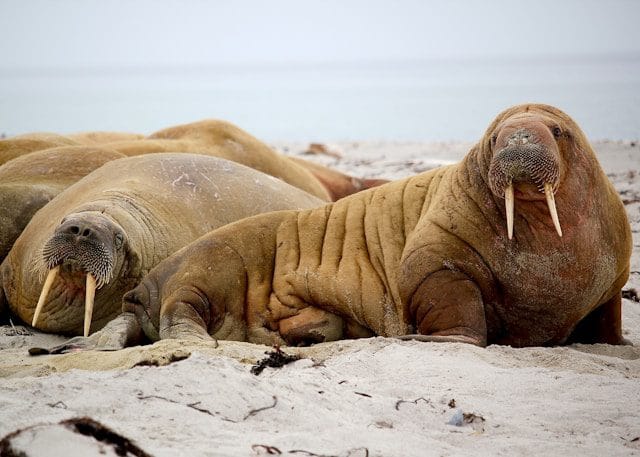
The appearance and anatomy of the walrus are truly remarkable and unique. With its prominent, long ivory tusks, grizzly whiskers, tough, wrinkled brown-pink skin, and streamlined, rotund body with flippers, the walrus has a distinct and memorable look. They have a large, square-shaped head with two small eyes, a broad, flat nose and a dense mat of large, stiff whiskers (vibrissae) that can number between 400 and 700. Their two long, ivory tusks, which are the upper canine teeth, are present in both sexes. These tusks grow throughout their lives, and males typically have longer and thicker tusks than females. However, their small eyes are positioned on the sides of the head and can be protruded and retracted. The Walrus' skin is wrinkled, thick and sparsely covered with fine, brownish fur that can appear yellowish-brown or pink in warm weather due to increased blood flow, and grey after emerging from cold water. Additionally, they have a thick layer of blubber (up to 15 cm) beneath their skin.
Walruses typically range from 7.5 to 11.8 feet in length, with males being larger than females, and their calves are born at about 3 to 4.5 feet in length. The body length and weight of the walrus vary by subspecies. The Pacific walruses are generally slightly larger than the Atlantic walruses of the same gender. Adult Pacific males range from 8.9 to 11.8 feet in length, and can reach a maximum length of about 12 feet, while Pacific females are about 7.5 to 10 feet in length. On the other hand, walruses typically weigh from 400 to 1,700 kg, and their calves are born at about 45 to 75 kg. An adult walrus can weigh between 800 and 1,700 kg, with some exceptional males reaching up to 2,000 kg, while adult females typically weigh between 400 and 1,250 kg. Additionally, their ivory tusks are elongated canine teeth which can grow up to 3 feet long in males and slightly shorter in females.
When it comes to their anatomy, walrus's iconic tusks protrude from their upper jaws. These impressive canine teeth are used for a variety of purposes, including defence, cutting through the ice, playing a crucial role in mating displays, establishing dominance within their social groups and helping them haul themselves out of frigid Arctic waters onto ice floes and rocky shores with surprising agility given their size, while their other teeth are adapted for their diet of benthic invertebrates. Additionally, an air sac is present under their throat, which helps them float vertically while resting. The walrus whiskers with hundreds of stiff bristles play a crucial role in locating food on the seafloor. These highly sensitive vibrissae can detect even the tiniest movements or vibrations in the water, helping the walrus to forage effectively in its habitat. Furthermore, their callous skin is covered with short, coarse hair that helps protect them from harsh Arctic winds and icy waters while giving them an endearing whiskered look. The wrinkled appearance of their skin also helps increase surface area for improved blood flow, which is essential for regulating body temperature in extreme conditions.
Lastly, their specialised skeletal structure, particularly the robust bones in their powerful, flat, front flippers, enables them to effortlessly navigate ice floes and water, showcasing an impressive blend of agility and strength. Their streamlined large bodies are well-adapted to their aquatic lifestyle, showcasing an elegant combination of power and agility. Despite their size, walruses are surprisingly agile swimmers (though they are less agile than other pinnipeds) thanks to their powerful hind (pelvic flippers) flippers capable of propelling them through the water at impressive speeds. They also use them to rotate under their body for better mobility on land. The thick layer of blubber beneath their skin not only provides insulation but also adds buoyancy when swimming, as well as heat retention and even energy storage during lean times. All these unique traits come together to create one of nature's most fascinating creatures, the mighty walrus.
The habitat and distribution of walruses are closely tied to the presence of sea ice, as they rely on it for resting, giving birth, and accessing food. Walruses are primarily found in the Arctic Ocean and sub-Arctic seas of the Northern Hemisphere, specifically in the coastal areas of the Atlantic and Pacific Oceans. The Pacific walrus lives in the region of northern seas, ranging from Russia and Alaska, with a range between the Bering Sea to the Chukchi Sea and the Laptev Sea, while the Atlantic walrus is found in the coastal areas from northeastern Canada to Greenland, as well as parts of Norway and Russia. They prefer icy waters but will use rocky islands if ice is unavailable. In the Arctic, these massive marine mammals can be found in the shallow coastal waters, including ice-covered waters of the continental shelf, where they can easily dive for their preferred prey of molluscs and other bottom-dwelling organisms. Interestingly, walruses have been observed to migrate with the movement of sea ice, travelling hundreds of miles in search of suitable feeding grounds. However, with the impact of climate change leading to diminishing sea ice, the walrus population is facing significant challenges as their habitat continues to shrink.
Their distribution is largely confined to the Arctic Ocean and sub-Arctic seas during certain times of the year. The Pacific populations extend from the Bering Strait to Bristol Bay in Alaska to the west as far as the Kamchatka Peninsula. They haul out on islands, those near St. Lawrence islands and the Pribilof islands. Pacific walruses migrate seasonally between the Bering Sea (in winter) and the Chukchi Sea (in summer). On the other hand, the Atlantic population specifically inhabits coastal areas from northeastern Canada to Greenland. These subspecies are further broken down into several distinct geographically separated stocks or populations. Both subspecies are associated with seasonally ice-covered waters and often use ice as a resting platform.
Their ability to adapt their distribution based on seasonal variations sets them apart from many other marine mammals. However, climate change is posing a significant threat to their habitat and distribution. As temperatures rise and sea ice melts at an alarming rate, walruses are being forced to adapt to rapidly changing conditions or seek new areas for survival. This has led to increased human-walrus interactions as they come ashore more frequently due to diminishing floating ice platforms, a complex issue that requires both conservation efforts and careful management strategies.
Commonly found in the Arctic and sub-Arctic regions, walruses are powerful and fascinating creatures that have adapted to life both on land and in the icy waters of the northern seas. They are typically categorised into two common types:
They are geographically distinct subspecies of the single species "Odobenus rosmarus". Some scientists also recognise a third subspecies, (Debatably) the Laptev walrus (Odobenus rosmarus laptevi), which is found in the Laptev Sea and is sometimes grouped with the Pacific subspecies. Each subspecies has varying characteristics and habitats that make it distinct from the other.
The Atlantic walrus (Odobenus rosmarus rosmarus) is characterised by its smaller size and shorter tusks. They prefer shallow waters to hunt for their favourite prey, clams. It can be found in the northern waters of the Atlantic Ocean, from the coastal areas of northeastern Canada and Greenland to Norway and Russia.
In contrast, the Pacific walrus (Odobenus rosmarus divergens) is known for its larger size, broader skull and longer tusks compared to other subspecies, with males weighing up to 2,000kg. They inhabit the northern waters of the Pacific Ocean, including the Bering and Chukchi Seas, from the coast of Russia and Alaska, often relying on sea ice platforms for resting and raising their young. Pacific walruses migrate seasonally between the Bering Sea (in winter) and the Chukchi Sea (in summer).
Finally, the Laptev walrus (Odobenus rosmarus laptevi) is typically found in the Laptev Sea, the eastmost regions of the Kara Sea and the westmost regions of the East Siberian Sea in Russia's Arctic region, where it navigates through ice floes to seek out molluscs for sustenance, with features that fall between those of the Pacific and Atlantic varieties.
These diverse habitats shape each subspecies' behaviour and survival strategies.
Walruses have a large, streamlined, bulky body with a large, square-shaped head that has a broad, flat nose, a thick moustache of hundreds of stiff bristles and two long upper tusks (elongated canine teeth), present in both sexes. They are well-known for their gregarious nature, often gathering in large herds on drifting ice or sandy beaches during different seasons. These sociable creatures possess unique adaptations such as a thick layer of blubber that provides insulation and buoyancy control in frigid environments and serves as a valuable energy reserve during long migrations. Their preferred habitats include shallow shelf areas along coastlines or pack ice, where they can easily dive to hunt for molluscs, clams, crustaceans, fish and other benthic organisms. They use their sensitive whiskers to detect prey in murky waters on the ocean floor, then use strong suction from their mouths to suck up prey from muddy substrates. Walruses have a remarkable ability to dive to depths of 300 feet or more in search of these delectable treats. Their long tusks (elongated canine teeth) can grow up to 3 feet long, primarily used for hunting for food, and hauling or pulling themselves out of frigid waters onto ice floes. These impressive tusks are also used for navigating through icy waters, as well as for defence against predators such as polar bears or orcas, and displaying dominance during mating seasons. Despite their size, they are remarkably agile creatures both underwater and on land, where they spend time basking in the sun or resting after exhausting feeding sessions. As human activity affects their habitat and climate change continues to impact their icy realms with diminishing sea ice and altered food availability, understanding the complex relationship between these magnificent animals and their rapidly changing habitats becomes increasingly vital for conservation efforts.
In terms of habitats, walruses are primarily found in frigid waters of the Arctic Ocean and sub-Arctic Seas, where they inhabit both coastal areas and pack ice. They are highly adapted to these harsh environments and are associated with seasonally ice-covered waters, often using sea ice as resting platforms during their long migrations. In addition to coastal zones and pack ice regions, these magnificent creatures also exhibit a preference for shallow shelf waters where they can dive down to feed on clams, snails, and other bottom-dwelling marine organisms. This adaptability allows them to thrive across a variety of landscapes within their icy habitat.
The diet and prey of the walrus are diverse and reflect its ability to adapt to the varying environmental conditions of Arctic marine life. These massive creatures primarily feast on a diverse array of benthic invertebrates, with their favourite delicacies including clams, molluscs, mussels, and various species of worms. Walruses also consume a wide range of other prey, including crustaceans (like shrimp and soft-shell crabs), sea cucumbers, snails, cephalopods and other soft-bodied invertebrates found on the seabed. However, their diet isn't limited to just molluscs or snails; they also hunt for fish (such as polar cod to herring), sea slugs, and, rarely, the carcasses of seals or even directly hunt them. Occasionally, especially when food is scarce, walruses may prey on seals if the opportunity arises, but this is not their typical food source. As apex predators in their icy domain, walruses play an essential role in maintaining ecological balance. Their feeding habits not only shape the distribution of other marine species but also contribute to nutrient cycling within Arctic ecosystems, underscoring their indispensable status within this unique habitat.
Interestingly, walruses can dive to great depths up to 300 feet to forage for food. This unique hunting style allows them to access a wider range of prey that may not be available near the surface. Despite being primarily bottom feeders, walruses are opportunistic hunters and will take advantage of any available food sources they encounter during their foraging expeditions. Moreover, walruses can locate their prey in icy waters using their sensitive whiskers and keen sense of smell before using their powerful suction to extract their food from the substrate. This allows them to forage along the seafloor with astonishing precision despite limited visibility. Additionally, they use their tusks not only for defence and communication but also as an aid in breaking through ice or digging for prey. With a resourceful approach to hunting and an adaptive diet, it's no wonder that these captivating marine mammals have thrived in some of Earth's most extreme environments for centuries. This unique combination of bottom-feeding and deep-sea hunting showcases the walrus’s remarkable adaptability as a predator within its Arctic habitat.
The behaviour and lifestyle of the walrus are intricately tied to their unique natural habitat in the Arctic and sub-Arctic regions. Known for their gregarious nature, walruses often congregate in large herds on floating ice or shorelines during different seasons. These gatherings serve multiple purposes, including providing protection from predators, facilitating mating rituals and support during migration. Within the herd, there is a clear hierarchy based on size and age, with dominant individuals often asserting their presence through physical displays and vocalisations, while the females form close-knit bonds with their young and engage in cooperative behaviours such as group feeding. In addition, walruses have intricate communication methods, using a combination of vocalisations like bell-like calls, grunts, bellows and roars that they use to communicate with one another both underwater and on land. This vocalisation serves various functions, such as maintaining group cohesion during haul-outs or signalling aggression or distress during interactions with rivals or predators. They also use physical gestures to maintain social cohesion within their groups, and this communal behaviour is integral to their survival in the harsh Arctic conditions. These remarkable creatures are known for their playful nature, frequently engaging in water acrobatics and displaying a sense of curiosity towards their surroundings.
In addition to their gregarious nature, walruses exhibit remarkable adaptability in their lifestyle. They are well-known for being semi-aquatic creatures, spending much of their time both on land and in the water. Furthermore, the lifestyle of the walrus is intricately linked to their environment, as these creatures rely heavily on sea ice where they haul out in large numbers to rest, give birth and avoid potential threats such as polar bears and orcas. They form tight-knit communities and can often be seen basking together on sea ice or rocky shores. Their unique lifestyle also includes diving to great depths in search of food, using their specialised whiskers to locate prey and impressive tusks to forage for molluscs, clams, snails, and other bottom-dwelling creatures on the seafloor, which they suck up from the ocean floor with their powerful mouths. These massive marine mammals spend much of their time swimming and foraging for food in the frigid waters. Furthermore, walruses have been observed travelling great distances during migration, navigating through icy waters with ease thanks to their specialised flipper-like limbs. This level of adaptability is a key survival trait that has allowed walruses to thrive in the harsh Arctic environment.
As climate change continues to impact the Arctic region, the behaviour and lifestyle of walruses face significant challenges. The reduction in sea ice not only affects their habitat but also limits access to important feeding grounds. Consequently, understanding the behaviour and lifestyle of walruses is crucial for developing conservation strategies that can protect these remarkable animals and ensure their survival in a rapidly changing world.
The reproduction, babies, and lifespan of walruses are fascinating aspects of these incredible creatures. Female walruses reach sexual maturity at around 4 to 6 years old, while males become sexually mature slightly later at 7 to 10 years. Once mature, female walruses will give birth to a single calf every 2 to 3 years, usually in the spring or early summer. Mating occurs in the water, and the breeding behaviour of walruses is a spectacle to behold. During the mating season, male walruses engage in intense battles for dominance and territory, showcasing their strength and agility in impressive displays. This involves loud vocalisations, physical displays, and tusk jousting, creating a spectacle of power and determination in the icy Arctic waters. The successful males then establish harems of females with whom they mate during the brief mating season. After successful mating, female walruses undergo a gestation period of about 15 to 16 months (one of the longest among marine mammals) before giving birth to a single calf on ice floes or land due to delayed implantation of the embryo, which can last up to 4 months.
Newborn walrus calves are incredibly adorable creatures and remarkably large, weighing around 45 to 75 kg and 3 to 4 feet long at birth, already possessing a thick layer of blubber to keep them warm in the frigid Arctic waters. They rely on their mothers for warmth and nutrition during the critical early stages of life. Walrus milk is composed of fat, protein and water, providing rich nutrients for a nursing calf. Despite their initial reliance on their mothers, walrus calves grow rapidly; by their first birthday, they can weigh anywhere from 181 to 363 kg. The bond between mother and calf is incredibly strong, with the mother providing all the care, protection and nourishment needed for the first 2 years before the calf becomes independent. As social animals, they form bonds within their herds that aid in their survival and well-being.
The lifespan of walruses is also remarkable. With an average lifespan of 20 to 30 years in the wild, these intelligent marine mammals can live up to 40 years, showcasing their resilience and adaptability in harsh Arctic conditions. This impressive longevity can be attributed to their slow reproductive rate and formidable adaptation to their environment. However, threats such as climate change and hunting put pressure on these magnificent creatures, making it crucial for conservation efforts to protect their future existence in our world's ecosystems.
Walruses, despite their imposing size and formidable tusks, face a range of predators and threats in their Arctic and sub-Arctic habitats. One of their main natural predators is the polar bear, which utilises its powerful swimming abilities to ambush unsuspecting walruses as they rest on sea ice or haul out onto beaches. Another primary predators of walruses are orcas, also known as killer whales. Although not a regular part of their diet, these apex predators often target young walruses in shallow waters along the Arctic coastline, using their intelligence and teamwork to isolate and overpower their prey. They have also been observed preying on injured walruses in certain situations, using coordinated strategies to separate them from their herds. As the Arctic environment continues to change, interactions between killer whales and walruses will likely become more frequent as their ranges overlap more frequently.
The largest threat to walruses comes from human activities such as hunting, oil and gas exploration and shipping. Inuit hunters traditionally hunt walruses for food and other resources, but the advent of commercial hunting has put significant pressure on walrus populations. Illegal hunting and poaching are driven by demand for their ivory tusks as well as traditional subsistence hunting in some communities. This exploitation can have severe impacts on local walrus populations, especially when combined with other stressors such as pollution and disturbance from industrial activities. Additionally, climate change is posing a new threat to these magnificent creatures. The loss of sea ice due to warming temperatures is reducing the availability of preferred feeding grounds for walruses, forcing them to travel greater distances and spend more time on land, where they are more vulnerable to predation from human disturbances. Conservation efforts must focus on addressing these multifaceted challenges to secure a sustainable future for these iconic marine mammals.
The population number of walruses is a topic of increasing concern as these iconic creatures face significant threats to their survival. The total walrus population is estimated to be around 250,000 to 260,000 individuals, with the vast majority being Pacific Walruses. They inhabit the Arctic and sub-Arctic regions, where they rely on sea ice for breeding and hauling out. The population is broken down by region, and currently, estimates suggest that there are around 200,000 Pacific walruses, 20,000 to 40,000 Atlantic walruses, and 10,000 Laptev sea walruses left in the world. Despite these numbers seeming substantial at first glance, it's important to note that these populations face considerable threats. With the increasing threat of climate change and habitat loss, conservation efforts have become crucial to safeguarding these unique creatures.
Climate change poses a serious risk to their habitat, as melting sea ice due to global warming reduces the availability of suitable resting and feeding grounds for these marine mammals. The resulting overcrowding can lead to increased stress, limited food resources, and higher disease susceptibility. Moreover, human disturbances have influenced the distribution and abundance of walrus populations, creating added pressures on their already vulnerable status. Unsustainable hunting practices in the past have had long-lasting impacts on their overall numbers. Furthermore, industrial activities such as oil and gas exploration pose additional threats to walruses. The loud noises from seismic surveys and drilling operations can disrupt their communication patterns and vital behaviours like hunting and reproduction. Researchers and environmental organisations need to continue monitoring these trends closely and implement measures to protect their habitats.
The importance of walruses in the ecosystem cannot be overstated.
Walruses are magnificent creatures that often steal the show in zoos and aquariums. Their massive size, distinctive tusks and appearances with endearing whiskers make them a must-see for visitors of all ages. Observing these gentle giants as they gracefully glide through the water or bask lazily on the rocks can be a mesmerising experience. It's not just their physical presence that captures attention, but also their social dynamics and unique behaviours within their carefully curated environments.
Visitors to zoos and aquariums have an unparalleled opportunity to learn about walrus conservation efforts and the critical role these animals play in marine ecosystems. These educational experiences can inspire a newfound appreciation for wildlife and ignite a passion for environmental preservation. Through up-close encounters with walruses, viewers can gain deep insights into their intelligence, adaptability, and complex communication skills. Whether it's through interactive feeding sessions or informative presentations by animal care specialists, witnessing these incredible creatures in person fosters meaningful connections between humans and the natural world.
As ambassadors for their wild counterparts, zoo and aquarium-dwelling walruses serve as powerful advocates for ocean conservation. By engaging with these majestic beings up close, visitors become more motivated to support initiatives aimed at protecting marine habitats and advocating for sustainable practices. Overall, experiencing walruses in captivity offers a chance not only for entertainment but also for meaningful education and action toward preserving our planet's precious biodiversity.
The classification and evolution of the walrus is a fascinating subject that sheds light on the unique adaptations and evolutionary history of these iconic marine mammals. From a taxonomic standpoint, walruses belong to the family Odobenidae and are further categorised into the genus "Odobenus", comprising a single living species: "Odobenus rosmarus", which is divided into 3 types or subspecies:
Their closest living relatives are not other pinnipeds like seals or sea lions, but rather they share a common ancestor with bears. Their unique tusked appearance sets them apart as one of the most charismatic creatures in their natural habitat. This surprising evolutionary link highlights the complex web of relationships between different groups of mammals and underscores the adaptability of these extraordinary creatures.
The evolutionary journey of walruses offers intriguing insights into how they have thrived in their Arctic environment over millions of years. Fossil evidence indicates that early ancestral forms had limbs adapted for movement on land, eventually developing streamlined bodies for efficient swimming in their marine environment. Through natural selection and environmental pressures, walruses gradually evolved their specialised aquatic adaptations such as streamlined bodies, flipper-like limbs for efficient swimming, and uniquely modified tusks for foraging on the seabed. This evolutionary journey sheds light on how these graceful behemoths have adapted to thrive in some of the harshest conditions on our planet.
The relationship between walruses and humans is a fascinating interplay of ancient traditions and modern challenges. For centuries, indigenous peoples have coexisted with these majestic creatures, relying on them for sustenance and cultural significance. Their existence has been intertwined with the lives of these communities for centuries, providing food, tools, and materials essential for survival in the harsh Arctic environment. However, as human activities encroach upon the walrus's natural habitat, this delicate balance is being tested in unprecedented ways.
While some communities continue to forge connections with these magnificent creatures through sustainable hunting practices and cultural rituals, others are grappling with the impact of climate change and human activities such as shipping, oil exploration and industrial development on walrus populations. The struggle to find common ground between the needs of both species underscores the complexities of conservation efforts in the rapidly changing Arctic environment.
While efforts to mitigate these conflicts are underway through conservation initiatives and sustainable resource management, it's clear that a deeper understanding of the intricate dynamics between walruses and humans is crucial for their survival. Finding a balance that respects the needs of both parties is essential for ensuring a harmonious cohabitation in the future.
The conservation status of the walrus has been a topic of growing concern in recent years. While they are currently classified as "Least Concern" by the International Union for Conservation of Nature (IUCN), several factors threaten their population. Climate change, leading to melting sea ice and loss of habitat, is one of the most significant challenges facing walruses today. As their primary source of food and breeding grounds, sea ice is crucial for their survival. The International Union for Conservation of Nature (IUCN) has listed the two species of walrus, the Pacific and Atlantic walrus, as "vulnerable" due to declining population trends.
In addition to climate change, walruses also face threats from human activities such as shipping, oil and gas exploration, and hunting. These activities not only directly impact walrus populations but also disrupt their natural behaviours and migratory patterns. It is essential for conservation efforts to address both the immediate threats facing walruses as well as the long-term impacts of climate change on their habitat.
Despite being labelled as "Least Concern", it's vital to recognise the fragile balance that supports the walrus population. Increased awareness, research, and sustainable management practices are necessary to ensure the long-term survival of these iconic marine mammals. Listening to indigenous communities' traditional knowledge about walrus behaviour can also provide valuable insights into effective conservation strategies. By taking comprehensive action now, we can work towards ensuring a brighter future for these magnificent creatures.
Walruses and Seals are both fascinating creatures that inhabit the icy waters of the Arctic and Antarctic, but they have some distinct differences.